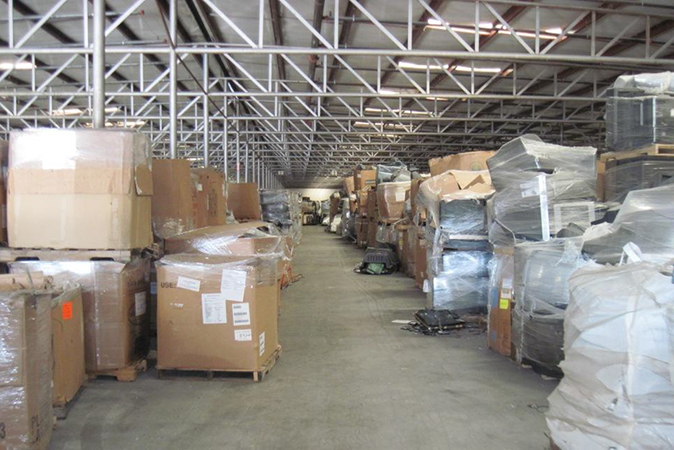
 About 8 million pounds of TVs are stored on pallets at the former GES site in Winchester, Ky. | Courtesy of Kentucky Division of Waste Management.[/caption]
In Kentucky, a treatment additive will be mixed into millions of pounds of leaded CRT glass, allowing for relatively cheap disposal of the problematic material in a non-hazardous waste landfill.
The additive approach is being used for a nearly $3 million CRT cleanup underway in north-central Kentucky, where state and local officials are dealing with the glass left behind by shuttered processor Global Environmental Services (GES).
GES failed in late 2015, leaving millions of pounds of CRT glass at its three Kentucky locations: Georgetown, Cynthiana and Winchester. A landlord already paid to clean up materials GES buried at its Georgetown location, and the Kentucky Department of Environmental Protection contracted with Chase Environmental Group for the cleanup of outdoor leaded sand piles in Georgetown and Cynthiana.
Since then, government officials and Louisville, Ky.-based Chase have turned their attention to planning the cleanup of 26 million pounds stored inside the Cynthiana and Winchester facilities.
An interview and documents obtained by E-Scrap News provide a window into how crews will conduct the cleanup, how the costs break down and how long it will take.
About 8 million pounds of TVs are stored on pallets at the former GES site in Winchester, Ky. | Courtesy of Kentucky Division of Waste Management.[/caption]
In Kentucky, a treatment additive will be mixed into millions of pounds of leaded CRT glass, allowing for relatively cheap disposal of the problematic material in a non-hazardous waste landfill.
The additive approach is being used for a nearly $3 million CRT cleanup underway in north-central Kentucky, where state and local officials are dealing with the glass left behind by shuttered processor Global Environmental Services (GES).
GES failed in late 2015, leaving millions of pounds of CRT glass at its three Kentucky locations: Georgetown, Cynthiana and Winchester. A landlord already paid to clean up materials GES buried at its Georgetown location, and the Kentucky Department of Environmental Protection contracted with Chase Environmental Group for the cleanup of outdoor leaded sand piles in Georgetown and Cynthiana.
Since then, government officials and Louisville, Ky.-based Chase have turned their attention to planning the cleanup of 26 million pounds stored inside the Cynthiana and Winchester facilities.
An interview and documents obtained by E-Scrap News provide a window into how crews will conduct the cleanup, how the costs break down and how long it will take.
[caption id="attachment_10675" align="aligncenter" width="674"] About 8 million pounds of TVs are stored on pallets at the former GES site in Winchester, Ky. | Courtesy of Kentucky Division of Waste Management.[/caption]
In Kentucky, a treatment additive will be mixed into millions of pounds of leaded CRT glass, allowing for relatively cheap disposal of the problematic material in a non-hazardous waste landfill.
The additive approach is being used for a nearly $3 million CRT cleanup underway in north-central Kentucky, where state and local officials are dealing with the glass left behind by shuttered processor Global Environmental Services (GES).
GES failed in late 2015, leaving millions of pounds of CRT glass at its three Kentucky locations: Georgetown, Cynthiana and Winchester. A landlord already paid to clean up materials GES buried at its Georgetown location, and the Kentucky Department of Environmental Protection contracted with Chase Environmental Group for the cleanup of outdoor leaded sand piles in Georgetown and Cynthiana.
Since then, government officials and Louisville, Ky.-based Chase have turned their attention to planning the cleanup of 26 million pounds stored inside the Cynthiana and Winchester facilities.
An interview and documents obtained by E-Scrap News provide a window into how crews will conduct the cleanup, how the costs break down and how long it will take.
About 8 million pounds of TVs are stored on pallets at the former GES site in Winchester, Ky. | Courtesy of Kentucky Division of Waste Management.[/caption]
In Kentucky, a treatment additive will be mixed into millions of pounds of leaded CRT glass, allowing for relatively cheap disposal of the problematic material in a non-hazardous waste landfill.
The additive approach is being used for a nearly $3 million CRT cleanup underway in north-central Kentucky, where state and local officials are dealing with the glass left behind by shuttered processor Global Environmental Services (GES).
GES failed in late 2015, leaving millions of pounds of CRT glass at its three Kentucky locations: Georgetown, Cynthiana and Winchester. A landlord already paid to clean up materials GES buried at its Georgetown location, and the Kentucky Department of Environmental Protection contracted with Chase Environmental Group for the cleanup of outdoor leaded sand piles in Georgetown and Cynthiana.
Since then, government officials and Louisville, Ky.-based Chase have turned their attention to planning the cleanup of 26 million pounds stored inside the Cynthiana and Winchester facilities.
An interview and documents obtained by E-Scrap News provide a window into how crews will conduct the cleanup, how the costs break down and how long it will take.
Categories