 In the days and weeks following George Floyd’s death, the Black cries against injustice were joined by voices from the rest of society in a way not seen in decades.[/caption]
Perhaps the ultimate white privilege is simply being able to look away.
I am a white middle-class male, brought up in a white middle-class suburb in New England. I was educated early on about the importance of the civil rights movement. I was exposed to and moved by the powerful words of Dr. Martin Luther King, Jr.
And I’ve been able to see with my own eyes the way racism continues to hold down black America: Another racially charged shooting in the news. Another statistic showing the disproportionate number of black people in U.S. prisons. Another gathering of business leaders with very few black faces in the crowd.
I also have the convenient option of putting discrimination against black people – both the shocking and subtle manifestations – into an ever-widening folder in a file cabinet in the back of my mind. These are important things that I know cannot simply be disregarded. But, ultimately, I have always been able to close the file cabinet door, leaving the actual reckoning for a later time.
Amid the current social unrest in our country around the killing of George Floyd in Minneapolis, I still have that option. I can learn the details, attend an event or two, make a donation, and then go back to my day-to-day world of relative safety and comfort.
I suspect that many readers of this publication can relate. Many of us who are decision-makers in the materials recovery industry come from the same fold of white society that I do. We are troubled by our country’s racial problems, and we want change for the better.
But the issue seems so complex and fraught with emotion that the natural course of action is to pay respect and then slowly step away – usually in silence, for we never want to say the wrong thing.
In the days and weeks following George Floyd’s death, the Black cries against injustice were joined by voices from the rest of society in a way not seen in decades.[/caption]
Perhaps the ultimate white privilege is simply being able to look away.
I am a white middle-class male, brought up in a white middle-class suburb in New England. I was educated early on about the importance of the civil rights movement. I was exposed to and moved by the powerful words of Dr. Martin Luther King, Jr.
And I’ve been able to see with my own eyes the way racism continues to hold down black America: Another racially charged shooting in the news. Another statistic showing the disproportionate number of black people in U.S. prisons. Another gathering of business leaders with very few black faces in the crowd.
I also have the convenient option of putting discrimination against black people – both the shocking and subtle manifestations – into an ever-widening folder in a file cabinet in the back of my mind. These are important things that I know cannot simply be disregarded. But, ultimately, I have always been able to close the file cabinet door, leaving the actual reckoning for a later time.
Amid the current social unrest in our country around the killing of George Floyd in Minneapolis, I still have that option. I can learn the details, attend an event or two, make a donation, and then go back to my day-to-day world of relative safety and comfort.
I suspect that many readers of this publication can relate. Many of us who are decision-makers in the materials recovery industry come from the same fold of white society that I do. We are troubled by our country’s racial problems, and we want change for the better.
But the issue seems so complex and fraught with emotion that the natural course of action is to pay respect and then slowly step away – usually in silence, for we never want to say the wrong thing.
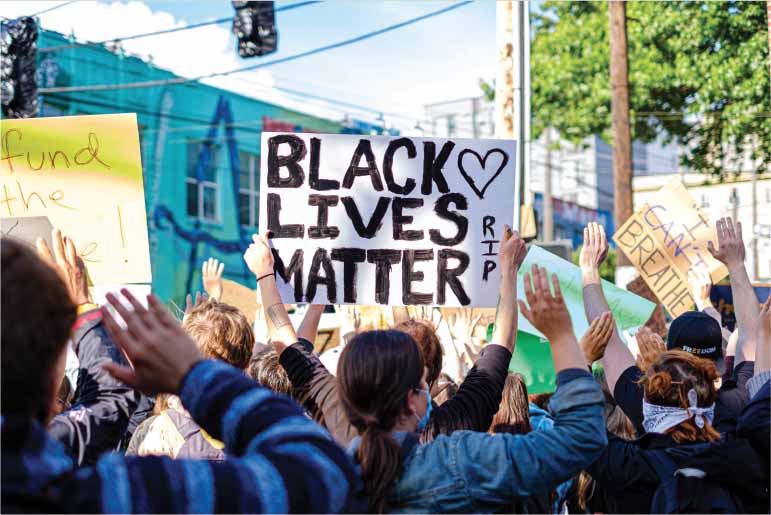
[caption id="" align="aligncenter" width="771"] In the days and weeks following George Floyd’s death, the Black cries against injustice were joined by voices from the rest of society in a way not seen in decades.[/caption]
Perhaps the ultimate white privilege is simply being able to look away.
I am a white middle-class male, brought up in a white middle-class suburb in New England. I was educated early on about the importance of the civil rights movement. I was exposed to and moved by the powerful words of Dr. Martin Luther King, Jr.
And I’ve been able to see with my own eyes the way racism continues to hold down black America: Another racially charged shooting in the news. Another statistic showing the disproportionate number of black people in U.S. prisons. Another gathering of business leaders with very few black faces in the crowd.
I also have the convenient option of putting discrimination against black people – both the shocking and subtle manifestations – into an ever-widening folder in a file cabinet in the back of my mind. These are important things that I know cannot simply be disregarded. But, ultimately, I have always been able to close the file cabinet door, leaving the actual reckoning for a later time.
Amid the current social unrest in our country around the killing of George Floyd in Minneapolis, I still have that option. I can learn the details, attend an event or two, make a donation, and then go back to my day-to-day world of relative safety and comfort.
I suspect that many readers of this publication can relate. Many of us who are decision-makers in the materials recovery industry come from the same fold of white society that I do. We are troubled by our country’s racial problems, and we want change for the better.
But the issue seems so complex and fraught with emotion that the natural course of action is to pay respect and then slowly step away – usually in silence, for we never want to say the wrong thing.
In the days and weeks following George Floyd’s death, the Black cries against injustice were joined by voices from the rest of society in a way not seen in decades.[/caption]
Perhaps the ultimate white privilege is simply being able to look away.
I am a white middle-class male, brought up in a white middle-class suburb in New England. I was educated early on about the importance of the civil rights movement. I was exposed to and moved by the powerful words of Dr. Martin Luther King, Jr.
And I’ve been able to see with my own eyes the way racism continues to hold down black America: Another racially charged shooting in the news. Another statistic showing the disproportionate number of black people in U.S. prisons. Another gathering of business leaders with very few black faces in the crowd.
I also have the convenient option of putting discrimination against black people – both the shocking and subtle manifestations – into an ever-widening folder in a file cabinet in the back of my mind. These are important things that I know cannot simply be disregarded. But, ultimately, I have always been able to close the file cabinet door, leaving the actual reckoning for a later time.
Amid the current social unrest in our country around the killing of George Floyd in Minneapolis, I still have that option. I can learn the details, attend an event or two, make a donation, and then go back to my day-to-day world of relative safety and comfort.
I suspect that many readers of this publication can relate. Many of us who are decision-makers in the materials recovery industry come from the same fold of white society that I do. We are troubled by our country’s racial problems, and we want change for the better.
But the issue seems so complex and fraught with emotion that the natural course of action is to pay respect and then slowly step away – usually in silence, for we never want to say the wrong thing.
Categories