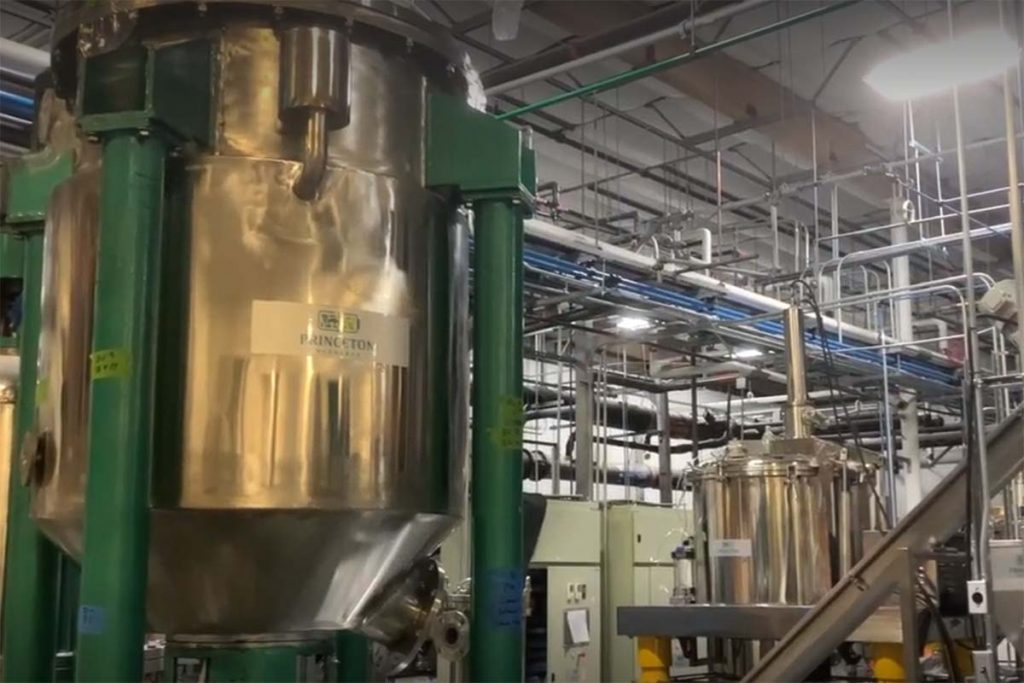
 Princeton NuEnergy on Oct. 25 opened a pilot direct lithium-ion battery recycling line in Texas. | Courtesy of Princeton NuEnergy[/caption]
A Princeton University recycling startup, in partnership with Wistron, brought a pilot project on-line, and Cirba Solutions secured a federal grant for a new facility, moving domestic lithium-ion battery recycling forward.
Princeton NuEnergy on Oct. 25 opened a pilot direct lithium-ion battery recycling line in Texas, debuting a plasma-based recovery process that performs cathode-to-cathode and anode-to-anode recycling without chemical leaching.
The technology was installed on Wistron's electronics recycling subsidiary company, Wistron GreenTech's, site in McKinney, Texas. The patented plasma-assisted recovery process can recover cathode and anode materials pure enough for direct reintroduction into cell manufacturing at half the cost and with less waste than more conventional methods, the company argued.
The process offers "a low cost, a low carbon footprint, and no hazardous emissions - all at a high recycling efficiency rate," according to the company’s statement, adding that it reduces CO2 emissions by 70% and has a cost reduction of 40% compared to conventional methods.
The technology works by shredding the batteries, then performing a physical separation of raw cathode and raw anode material, followed by plasma purification.
Compared to conventional methods such as pyro- and hydro-metallurgical processes, "which damages the cathode compound, takes lengthy steps to just go half-way through the cathode regeneration and induces a lot more chemical and energy waste," the plasma method does not rely on harsh chemicals and is also easier to scale up commercially, the company noted.
The pilot's processing capacity is 500 tons per year, with used batteries coming from Apple, Dell, Samsung and Call2Recycle.
In a press release, Yan Chao, founder and CEO of the clean-tech startup that spun out of Princeton University in 2019, said the "fully equipped facility is a powerful next step in our vision for covering a nationwide LIB close-loop recycling supply chain."
"We intend to be a major player in meeting the recycling needs of the US LIB marketplace," Chao added. "Our unique technology drastically reduces the time required for critical materials to re-enter the manufacturing supply chain - a major win for all LIB manufacturers."
"PNE's mission is to solve the current industry pain point of high-operational cost battery recycling and improve battery recycling efficiency and purity," according to the company’s statement.
Princeton NuEnergy raised $7 million in seed funding in 2021, and was previously awarded $100,000 from The Intellectual Property Accelerator Fund and two grants from the U.S. Department of Energy's Small Business Innovation Research (SBIR) program, a phase one grant for $250,000 and a phase two grant for $1.15 million.
The company plans to install more than 20 production lines across North America, an investment of over $600 million, by 2028. It seeks to prove that "lithium-ion battery direct recycling is solvable,” and it “is dedicated to achieving environmentally and socially conscious benchmarks in the direct recycling of lithium-ion batteries," according to its statement.
Princeton NuEnergy on Oct. 25 opened a pilot direct lithium-ion battery recycling line in Texas. | Courtesy of Princeton NuEnergy[/caption]
A Princeton University recycling startup, in partnership with Wistron, brought a pilot project on-line, and Cirba Solutions secured a federal grant for a new facility, moving domestic lithium-ion battery recycling forward.
Princeton NuEnergy on Oct. 25 opened a pilot direct lithium-ion battery recycling line in Texas, debuting a plasma-based recovery process that performs cathode-to-cathode and anode-to-anode recycling without chemical leaching.
The technology was installed on Wistron's electronics recycling subsidiary company, Wistron GreenTech's, site in McKinney, Texas. The patented plasma-assisted recovery process can recover cathode and anode materials pure enough for direct reintroduction into cell manufacturing at half the cost and with less waste than more conventional methods, the company argued.
The process offers "a low cost, a low carbon footprint, and no hazardous emissions - all at a high recycling efficiency rate," according to the company’s statement, adding that it reduces CO2 emissions by 70% and has a cost reduction of 40% compared to conventional methods.
The technology works by shredding the batteries, then performing a physical separation of raw cathode and raw anode material, followed by plasma purification.
Compared to conventional methods such as pyro- and hydro-metallurgical processes, "which damages the cathode compound, takes lengthy steps to just go half-way through the cathode regeneration and induces a lot more chemical and energy waste," the plasma method does not rely on harsh chemicals and is also easier to scale up commercially, the company noted.
The pilot's processing capacity is 500 tons per year, with used batteries coming from Apple, Dell, Samsung and Call2Recycle.
In a press release, Yan Chao, founder and CEO of the clean-tech startup that spun out of Princeton University in 2019, said the "fully equipped facility is a powerful next step in our vision for covering a nationwide LIB close-loop recycling supply chain."
"We intend to be a major player in meeting the recycling needs of the US LIB marketplace," Chao added. "Our unique technology drastically reduces the time required for critical materials to re-enter the manufacturing supply chain - a major win for all LIB manufacturers."
"PNE's mission is to solve the current industry pain point of high-operational cost battery recycling and improve battery recycling efficiency and purity," according to the company’s statement.
Princeton NuEnergy raised $7 million in seed funding in 2021, and was previously awarded $100,000 from The Intellectual Property Accelerator Fund and two grants from the U.S. Department of Energy's Small Business Innovation Research (SBIR) program, a phase one grant for $250,000 and a phase two grant for $1.15 million.
The company plans to install more than 20 production lines across North America, an investment of over $600 million, by 2028. It seeks to prove that "lithium-ion battery direct recycling is solvable,” and it “is dedicated to achieving environmentally and socially conscious benchmarks in the direct recycling of lithium-ion batteries," according to its statement.
[caption id="attachment_20046" align="aligncenter" width="900"] Princeton NuEnergy on Oct. 25 opened a pilot direct lithium-ion battery recycling line in Texas. | Courtesy of Princeton NuEnergy[/caption]
A Princeton University recycling startup, in partnership with Wistron, brought a pilot project on-line, and Cirba Solutions secured a federal grant for a new facility, moving domestic lithium-ion battery recycling forward.
Princeton NuEnergy on Oct. 25 opened a pilot direct lithium-ion battery recycling line in Texas, debuting a plasma-based recovery process that performs cathode-to-cathode and anode-to-anode recycling without chemical leaching.
The technology was installed on Wistron's electronics recycling subsidiary company, Wistron GreenTech's, site in McKinney, Texas. The patented plasma-assisted recovery process can recover cathode and anode materials pure enough for direct reintroduction into cell manufacturing at half the cost and with less waste than more conventional methods, the company argued.
The process offers "a low cost, a low carbon footprint, and no hazardous emissions - all at a high recycling efficiency rate," according to the company’s statement, adding that it reduces CO2 emissions by 70% and has a cost reduction of 40% compared to conventional methods.
The technology works by shredding the batteries, then performing a physical separation of raw cathode and raw anode material, followed by plasma purification.
Compared to conventional methods such as pyro- and hydro-metallurgical processes, "which damages the cathode compound, takes lengthy steps to just go half-way through the cathode regeneration and induces a lot more chemical and energy waste," the plasma method does not rely on harsh chemicals and is also easier to scale up commercially, the company noted.
The pilot's processing capacity is 500 tons per year, with used batteries coming from Apple, Dell, Samsung and Call2Recycle.
In a press release, Yan Chao, founder and CEO of the clean-tech startup that spun out of Princeton University in 2019, said the "fully equipped facility is a powerful next step in our vision for covering a nationwide LIB close-loop recycling supply chain."
"We intend to be a major player in meeting the recycling needs of the US LIB marketplace," Chao added. "Our unique technology drastically reduces the time required for critical materials to re-enter the manufacturing supply chain - a major win for all LIB manufacturers."
"PNE's mission is to solve the current industry pain point of high-operational cost battery recycling and improve battery recycling efficiency and purity," according to the company’s statement.
Princeton NuEnergy raised $7 million in seed funding in 2021, and was previously awarded $100,000 from The Intellectual Property Accelerator Fund and two grants from the U.S. Department of Energy's Small Business Innovation Research (SBIR) program, a phase one grant for $250,000 and a phase two grant for $1.15 million.
The company plans to install more than 20 production lines across North America, an investment of over $600 million, by 2028. It seeks to prove that "lithium-ion battery direct recycling is solvable,” and it “is dedicated to achieving environmentally and socially conscious benchmarks in the direct recycling of lithium-ion batteries," according to its statement.
Princeton NuEnergy on Oct. 25 opened a pilot direct lithium-ion battery recycling line in Texas. | Courtesy of Princeton NuEnergy[/caption]
A Princeton University recycling startup, in partnership with Wistron, brought a pilot project on-line, and Cirba Solutions secured a federal grant for a new facility, moving domestic lithium-ion battery recycling forward.
Princeton NuEnergy on Oct. 25 opened a pilot direct lithium-ion battery recycling line in Texas, debuting a plasma-based recovery process that performs cathode-to-cathode and anode-to-anode recycling without chemical leaching.
The technology was installed on Wistron's electronics recycling subsidiary company, Wistron GreenTech's, site in McKinney, Texas. The patented plasma-assisted recovery process can recover cathode and anode materials pure enough for direct reintroduction into cell manufacturing at half the cost and with less waste than more conventional methods, the company argued.
The process offers "a low cost, a low carbon footprint, and no hazardous emissions - all at a high recycling efficiency rate," according to the company’s statement, adding that it reduces CO2 emissions by 70% and has a cost reduction of 40% compared to conventional methods.
The technology works by shredding the batteries, then performing a physical separation of raw cathode and raw anode material, followed by plasma purification.
Compared to conventional methods such as pyro- and hydro-metallurgical processes, "which damages the cathode compound, takes lengthy steps to just go half-way through the cathode regeneration and induces a lot more chemical and energy waste," the plasma method does not rely on harsh chemicals and is also easier to scale up commercially, the company noted.
The pilot's processing capacity is 500 tons per year, with used batteries coming from Apple, Dell, Samsung and Call2Recycle.
In a press release, Yan Chao, founder and CEO of the clean-tech startup that spun out of Princeton University in 2019, said the "fully equipped facility is a powerful next step in our vision for covering a nationwide LIB close-loop recycling supply chain."
"We intend to be a major player in meeting the recycling needs of the US LIB marketplace," Chao added. "Our unique technology drastically reduces the time required for critical materials to re-enter the manufacturing supply chain - a major win for all LIB manufacturers."
"PNE's mission is to solve the current industry pain point of high-operational cost battery recycling and improve battery recycling efficiency and purity," according to the company’s statement.
Princeton NuEnergy raised $7 million in seed funding in 2021, and was previously awarded $100,000 from The Intellectual Property Accelerator Fund and two grants from the U.S. Department of Energy's Small Business Innovation Research (SBIR) program, a phase one grant for $250,000 and a phase two grant for $1.15 million.
The company plans to install more than 20 production lines across North America, an investment of over $600 million, by 2028. It seeks to prove that "lithium-ion battery direct recycling is solvable,” and it “is dedicated to achieving environmentally and socially conscious benchmarks in the direct recycling of lithium-ion batteries," according to its statement.
Categories