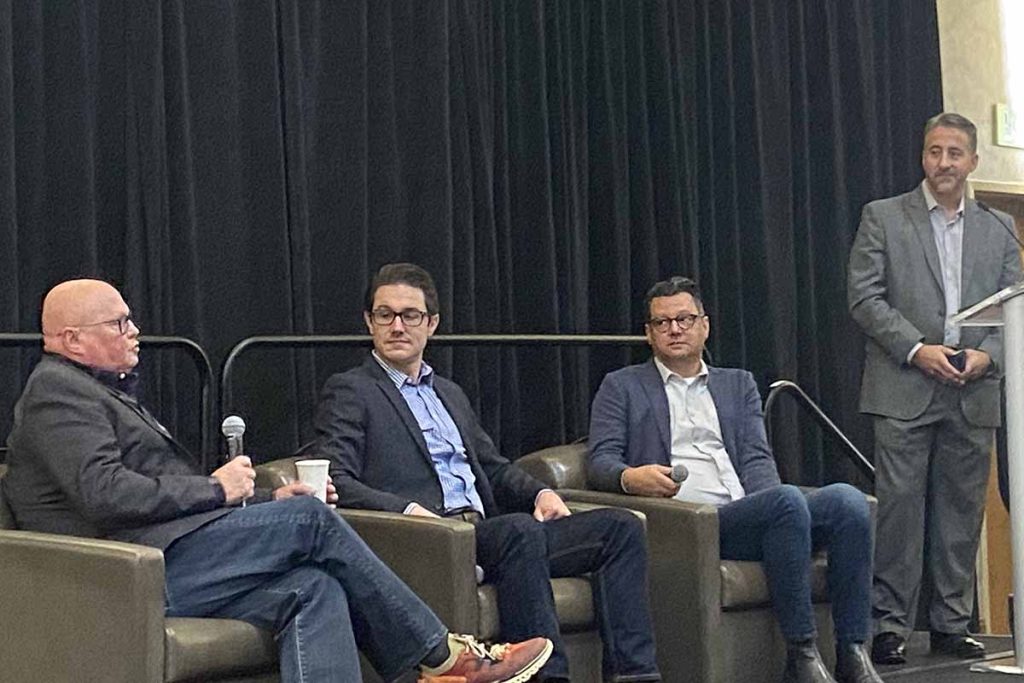
 The "Driving Circularity" panel included (from left) Paul Walker of Samsung, Scott Shackelford of Google, Drew Tosh from Dell and Corey Dehmey of SERI. | Dan Leif/Resource Recycling, Inc.[/caption]
Leaders from Dell, Google and Samsung laid out details this week on how their companies are building strategies around repair, device longevity and more.
The tech company representatives were brought together for a panel at the 2022 E-Reuse Conference, held Nov. 14 through Nov. 16 in Denver. All said they are focusing on efforts that move well beyond simply collecting end-of-life products for recycling.
For instance, Drew Tosh, director of experience design strategy at Dell Technologies, noted his team recently completed a two-year initiative called Project Luna. The goal: design a notebook computer that carries as little carbon impact as possible.
The work isn’t resulting in a new computer model sold to consumers. Instead, the initiative served to spark innovations that can be integrated across the Dell product portfolio in different ways.
The advances include a motherboard that's 75% smaller, a fanless system that reduces overall power needs, a "keystone" innovation that locks components in place without adhesives, and 10 times fewer screws than current laptop models.
"It's making a lot of teams at Dell question what they've been doing for the past 20 years," Tosh said.
The "Driving Circularity" panel included (from left) Paul Walker of Samsung, Scott Shackelford of Google, Drew Tosh from Dell and Corey Dehmey of SERI. | Dan Leif/Resource Recycling, Inc.[/caption]
Leaders from Dell, Google and Samsung laid out details this week on how their companies are building strategies around repair, device longevity and more.
The tech company representatives were brought together for a panel at the 2022 E-Reuse Conference, held Nov. 14 through Nov. 16 in Denver. All said they are focusing on efforts that move well beyond simply collecting end-of-life products for recycling.
For instance, Drew Tosh, director of experience design strategy at Dell Technologies, noted his team recently completed a two-year initiative called Project Luna. The goal: design a notebook computer that carries as little carbon impact as possible.
The work isn’t resulting in a new computer model sold to consumers. Instead, the initiative served to spark innovations that can be integrated across the Dell product portfolio in different ways.
The advances include a motherboard that's 75% smaller, a fanless system that reduces overall power needs, a "keystone" innovation that locks components in place without adhesives, and 10 times fewer screws than current laptop models.
"It's making a lot of teams at Dell question what they've been doing for the past 20 years," Tosh said.
[caption id="attachment_20223" align="aligncenter" width="900"] The "Driving Circularity" panel included (from left) Paul Walker of Samsung, Scott Shackelford of Google, Drew Tosh from Dell and Corey Dehmey of SERI. | Dan Leif/Resource Recycling, Inc.[/caption]
Leaders from Dell, Google and Samsung laid out details this week on how their companies are building strategies around repair, device longevity and more.
The tech company representatives were brought together for a panel at the 2022 E-Reuse Conference, held Nov. 14 through Nov. 16 in Denver. All said they are focusing on efforts that move well beyond simply collecting end-of-life products for recycling.
For instance, Drew Tosh, director of experience design strategy at Dell Technologies, noted his team recently completed a two-year initiative called Project Luna. The goal: design a notebook computer that carries as little carbon impact as possible.
The work isn’t resulting in a new computer model sold to consumers. Instead, the initiative served to spark innovations that can be integrated across the Dell product portfolio in different ways.
The advances include a motherboard that's 75% smaller, a fanless system that reduces overall power needs, a "keystone" innovation that locks components in place without adhesives, and 10 times fewer screws than current laptop models.
"It's making a lot of teams at Dell question what they've been doing for the past 20 years," Tosh said.
The "Driving Circularity" panel included (from left) Paul Walker of Samsung, Scott Shackelford of Google, Drew Tosh from Dell and Corey Dehmey of SERI. | Dan Leif/Resource Recycling, Inc.[/caption]
Leaders from Dell, Google and Samsung laid out details this week on how their companies are building strategies around repair, device longevity and more.
The tech company representatives were brought together for a panel at the 2022 E-Reuse Conference, held Nov. 14 through Nov. 16 in Denver. All said they are focusing on efforts that move well beyond simply collecting end-of-life products for recycling.
For instance, Drew Tosh, director of experience design strategy at Dell Technologies, noted his team recently completed a two-year initiative called Project Luna. The goal: design a notebook computer that carries as little carbon impact as possible.
The work isn’t resulting in a new computer model sold to consumers. Instead, the initiative served to spark innovations that can be integrated across the Dell product portfolio in different ways.
The advances include a motherboard that's 75% smaller, a fanless system that reduces overall power needs, a "keystone" innovation that locks components in place without adhesives, and 10 times fewer screws than current laptop models.
"It's making a lot of teams at Dell question what they've been doing for the past 20 years," Tosh said.
Categories