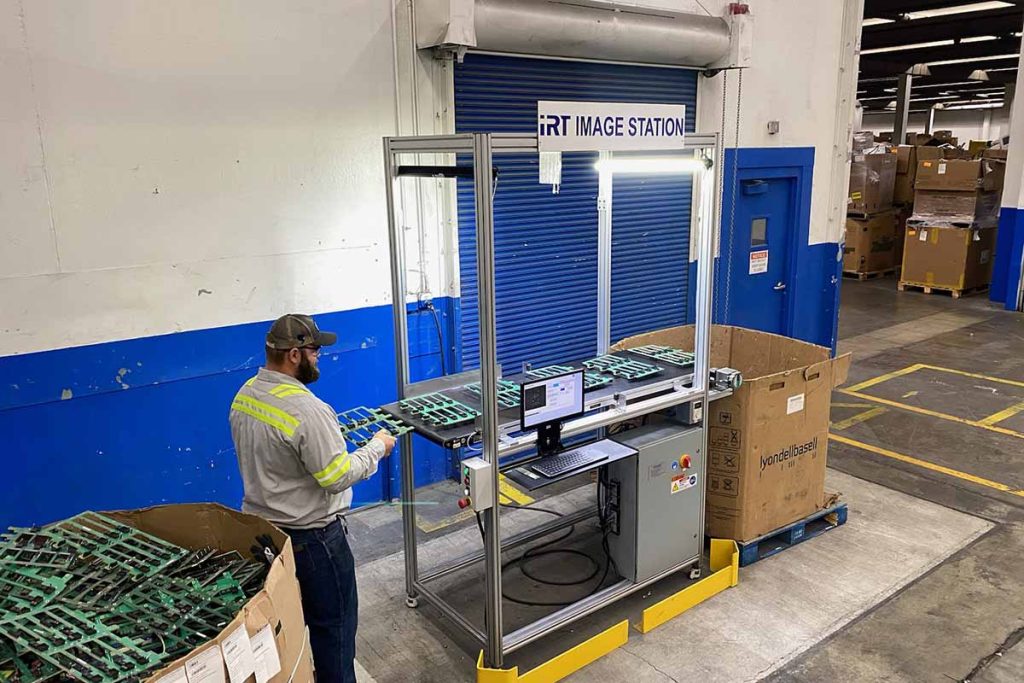
 IRT is capturing high-definition photos of printed circuit boards so AI-powered software can learn to categorize them by precious metals content. | Courtesy of IRT[/caption]
Integrated Recycling Technologies is developing an AI-powered app for its suppliers that will quickly categorize and price their scrap circuit boards before they ship them. The software will also power the company's own robotic circuit board sorting system.
The capabilities will bring pricing transparency and help Integrated Recycling Technologies (IRT) reduce staffing needs in difficult-to-fill printed circuit board (PCB) sorting jobs.
"The ability for our suppliers to have the information in hand whenever they want and to be able to train their sorters - or their supplier - I think it'll be really beneficial for the entire industry," Steve Budd, CEO of the St. Cloud, Minn.-based e-scrap company, told E-Scrap News in an interview.
The project is a new application for advanced visioning systems, deep-learning software and robotics, though the technologies themselves aren't brand new. Curbside recyclables sorting facilities, plastics reclaimers and even e-scrap recycling companies have been using AI-powered robots to identify and quickly sort scrap moving down a conveyor belt.
But the system IRT is working on won't sort materials by type - aluminum, steel, circuit boards, plastics, etc. It will quickly determine which of 53 categories of PCBs the material fits into, based on their gold content, and it will provide the current price, Budd explained.
IRT is capturing high-definition photos of printed circuit boards so AI-powered software can learn to categorize them by precious metals content. | Courtesy of IRT[/caption]
Integrated Recycling Technologies is developing an AI-powered app for its suppliers that will quickly categorize and price their scrap circuit boards before they ship them. The software will also power the company's own robotic circuit board sorting system.
The capabilities will bring pricing transparency and help Integrated Recycling Technologies (IRT) reduce staffing needs in difficult-to-fill printed circuit board (PCB) sorting jobs.
"The ability for our suppliers to have the information in hand whenever they want and to be able to train their sorters - or their supplier - I think it'll be really beneficial for the entire industry," Steve Budd, CEO of the St. Cloud, Minn.-based e-scrap company, told E-Scrap News in an interview.
The project is a new application for advanced visioning systems, deep-learning software and robotics, though the technologies themselves aren't brand new. Curbside recyclables sorting facilities, plastics reclaimers and even e-scrap recycling companies have been using AI-powered robots to identify and quickly sort scrap moving down a conveyor belt.
But the system IRT is working on won't sort materials by type - aluminum, steel, circuit boards, plastics, etc. It will quickly determine which of 53 categories of PCBs the material fits into, based on their gold content, and it will provide the current price, Budd explained.
[caption id="attachment_20410" align="aligncenter" width="900"] IRT is capturing high-definition photos of printed circuit boards so AI-powered software can learn to categorize them by precious metals content. | Courtesy of IRT[/caption]
Integrated Recycling Technologies is developing an AI-powered app for its suppliers that will quickly categorize and price their scrap circuit boards before they ship them. The software will also power the company's own robotic circuit board sorting system.
The capabilities will bring pricing transparency and help Integrated Recycling Technologies (IRT) reduce staffing needs in difficult-to-fill printed circuit board (PCB) sorting jobs.
"The ability for our suppliers to have the information in hand whenever they want and to be able to train their sorters - or their supplier - I think it'll be really beneficial for the entire industry," Steve Budd, CEO of the St. Cloud, Minn.-based e-scrap company, told E-Scrap News in an interview.
The project is a new application for advanced visioning systems, deep-learning software and robotics, though the technologies themselves aren't brand new. Curbside recyclables sorting facilities, plastics reclaimers and even e-scrap recycling companies have been using AI-powered robots to identify and quickly sort scrap moving down a conveyor belt.
But the system IRT is working on won't sort materials by type - aluminum, steel, circuit boards, plastics, etc. It will quickly determine which of 53 categories of PCBs the material fits into, based on their gold content, and it will provide the current price, Budd explained.
IRT is capturing high-definition photos of printed circuit boards so AI-powered software can learn to categorize them by precious metals content. | Courtesy of IRT[/caption]
Integrated Recycling Technologies is developing an AI-powered app for its suppliers that will quickly categorize and price their scrap circuit boards before they ship them. The software will also power the company's own robotic circuit board sorting system.
The capabilities will bring pricing transparency and help Integrated Recycling Technologies (IRT) reduce staffing needs in difficult-to-fill printed circuit board (PCB) sorting jobs.
"The ability for our suppliers to have the information in hand whenever they want and to be able to train their sorters - or their supplier - I think it'll be really beneficial for the entire industry," Steve Budd, CEO of the St. Cloud, Minn.-based e-scrap company, told E-Scrap News in an interview.
The project is a new application for advanced visioning systems, deep-learning software and robotics, though the technologies themselves aren't brand new. Curbside recyclables sorting facilities, plastics reclaimers and even e-scrap recycling companies have been using AI-powered robots to identify and quickly sort scrap moving down a conveyor belt.
But the system IRT is working on won't sort materials by type - aluminum, steel, circuit boards, plastics, etc. It will quickly determine which of 53 categories of PCBs the material fits into, based on their gold content, and it will provide the current price, Budd explained.
Categories