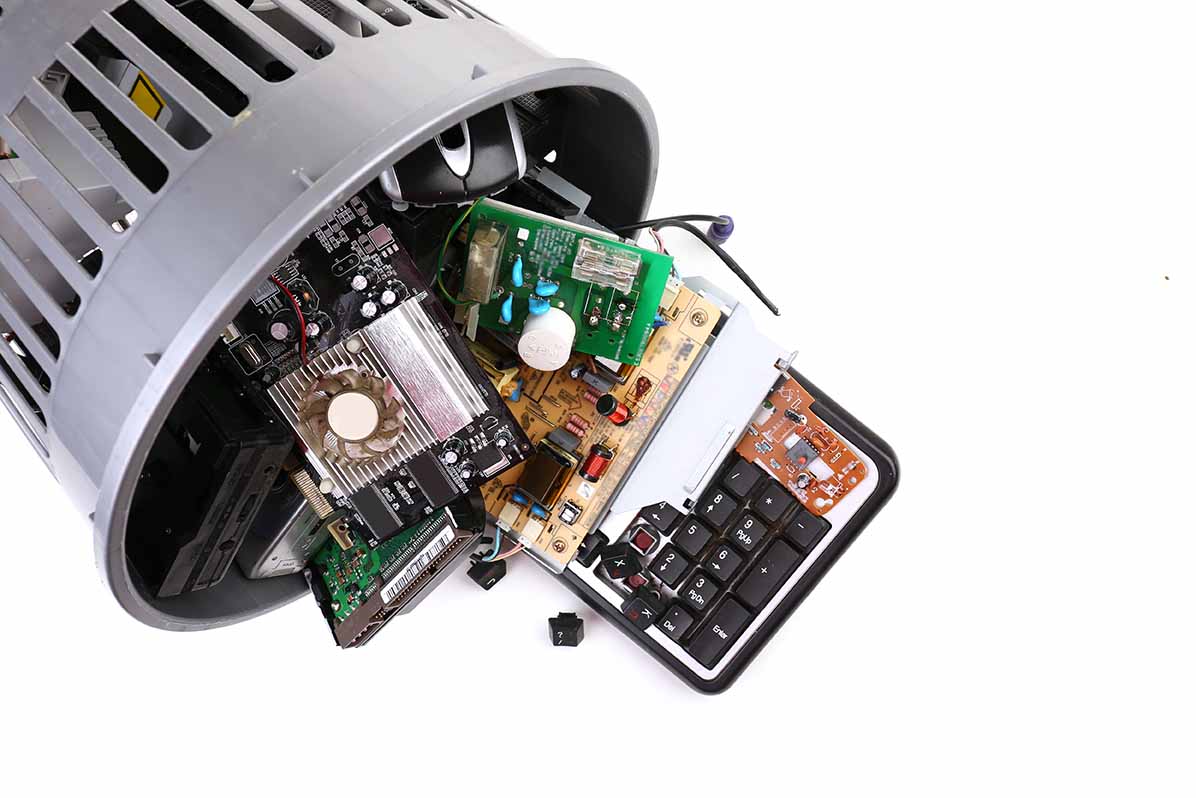
 Some aspects of the state’s e-waste law require clarification, but California officials expect a significant expansion of covered items.| Africa Studio/Shutterstock[/caption]
In the future, e-scrap processors in California could receive state money to recycle electric toothbrushes, electronic greeting cards, toys and a host of other items with embedded batteries, state regulators recently suggested.
The California Department of Resources Recycling and Recovery (CalRecycle) recently held a workshop to explore just what the signing into law of Senate Bill 1215 could mean for the country's oldest regulated e-scrap program. In short, it will entail major changes, even as substantial questions remain to be answered by forthcoming regulation.
"This is an expansion of our e-waste program, which is over 20 years old and has done a lot for the state of California to collect and appropriately recycle electronic waste for the people of California," said Rachel Machi Wagoner, director of CalRecycle, discussing how she was involved with crafting the original e-scrap program legislation while working in state government in the late 1990s. "The evolution of this program is very exciting to me."
California's Covered Electronic Waste (CEW) program, which went into effect in 2005, charges consumers a fee at the point of sale for video display devices (with at least 4-inch screens) that state Department of Toxic Substances Control (DTSC) scientists have determined contain toxic substances. The fee revenue is collected by the state and paid to registered processors when they properly recycle covered electronics, a list that currently includes several categories of TVs, monitors, laptops, portable DVD players and tablets.
Processors pay a portion of the state payment to e-scrap collectors.
The program currently has 293 approved e-scrap collectors and 20 approved recyclers, said Ana-Maria Stoian-Chu, manager of the CEW program at CalRecycle.
Last fall, legislators ushered in a huge expansion of the list of covered devices when they passed - and Gov. Gavin Newsom signed - SB 1215. The bill adds to the program all electronics with batteries that are embedded and aren't designed to be removed by consumers.
Some aspects of the state’s e-waste law require clarification, but California officials expect a significant expansion of covered items.| Africa Studio/Shutterstock[/caption]
In the future, e-scrap processors in California could receive state money to recycle electric toothbrushes, electronic greeting cards, toys and a host of other items with embedded batteries, state regulators recently suggested.
The California Department of Resources Recycling and Recovery (CalRecycle) recently held a workshop to explore just what the signing into law of Senate Bill 1215 could mean for the country's oldest regulated e-scrap program. In short, it will entail major changes, even as substantial questions remain to be answered by forthcoming regulation.
"This is an expansion of our e-waste program, which is over 20 years old and has done a lot for the state of California to collect and appropriately recycle electronic waste for the people of California," said Rachel Machi Wagoner, director of CalRecycle, discussing how she was involved with crafting the original e-scrap program legislation while working in state government in the late 1990s. "The evolution of this program is very exciting to me."
California's Covered Electronic Waste (CEW) program, which went into effect in 2005, charges consumers a fee at the point of sale for video display devices (with at least 4-inch screens) that state Department of Toxic Substances Control (DTSC) scientists have determined contain toxic substances. The fee revenue is collected by the state and paid to registered processors when they properly recycle covered electronics, a list that currently includes several categories of TVs, monitors, laptops, portable DVD players and tablets.
Processors pay a portion of the state payment to e-scrap collectors.
The program currently has 293 approved e-scrap collectors and 20 approved recyclers, said Ana-Maria Stoian-Chu, manager of the CEW program at CalRecycle.
Last fall, legislators ushered in a huge expansion of the list of covered devices when they passed - and Gov. Gavin Newsom signed - SB 1215. The bill adds to the program all electronics with batteries that are embedded and aren't designed to be removed by consumers.
[caption id="attachment_16346" align="aligncenter" width="1196"] Some aspects of the state’s e-waste law require clarification, but California officials expect a significant expansion of covered items.| Africa Studio/Shutterstock[/caption]
In the future, e-scrap processors in California could receive state money to recycle electric toothbrushes, electronic greeting cards, toys and a host of other items with embedded batteries, state regulators recently suggested.
The California Department of Resources Recycling and Recovery (CalRecycle) recently held a workshop to explore just what the signing into law of Senate Bill 1215 could mean for the country's oldest regulated e-scrap program. In short, it will entail major changes, even as substantial questions remain to be answered by forthcoming regulation.
"This is an expansion of our e-waste program, which is over 20 years old and has done a lot for the state of California to collect and appropriately recycle electronic waste for the people of California," said Rachel Machi Wagoner, director of CalRecycle, discussing how she was involved with crafting the original e-scrap program legislation while working in state government in the late 1990s. "The evolution of this program is very exciting to me."
California's Covered Electronic Waste (CEW) program, which went into effect in 2005, charges consumers a fee at the point of sale for video display devices (with at least 4-inch screens) that state Department of Toxic Substances Control (DTSC) scientists have determined contain toxic substances. The fee revenue is collected by the state and paid to registered processors when they properly recycle covered electronics, a list that currently includes several categories of TVs, monitors, laptops, portable DVD players and tablets.
Processors pay a portion of the state payment to e-scrap collectors.
The program currently has 293 approved e-scrap collectors and 20 approved recyclers, said Ana-Maria Stoian-Chu, manager of the CEW program at CalRecycle.
Last fall, legislators ushered in a huge expansion of the list of covered devices when they passed - and Gov. Gavin Newsom signed - SB 1215. The bill adds to the program all electronics with batteries that are embedded and aren't designed to be removed by consumers.
Some aspects of the state’s e-waste law require clarification, but California officials expect a significant expansion of covered items.| Africa Studio/Shutterstock[/caption]
In the future, e-scrap processors in California could receive state money to recycle electric toothbrushes, electronic greeting cards, toys and a host of other items with embedded batteries, state regulators recently suggested.
The California Department of Resources Recycling and Recovery (CalRecycle) recently held a workshop to explore just what the signing into law of Senate Bill 1215 could mean for the country's oldest regulated e-scrap program. In short, it will entail major changes, even as substantial questions remain to be answered by forthcoming regulation.
"This is an expansion of our e-waste program, which is over 20 years old and has done a lot for the state of California to collect and appropriately recycle electronic waste for the people of California," said Rachel Machi Wagoner, director of CalRecycle, discussing how she was involved with crafting the original e-scrap program legislation while working in state government in the late 1990s. "The evolution of this program is very exciting to me."
California's Covered Electronic Waste (CEW) program, which went into effect in 2005, charges consumers a fee at the point of sale for video display devices (with at least 4-inch screens) that state Department of Toxic Substances Control (DTSC) scientists have determined contain toxic substances. The fee revenue is collected by the state and paid to registered processors when they properly recycle covered electronics, a list that currently includes several categories of TVs, monitors, laptops, portable DVD players and tablets.
Processors pay a portion of the state payment to e-scrap collectors.
The program currently has 293 approved e-scrap collectors and 20 approved recyclers, said Ana-Maria Stoian-Chu, manager of the CEW program at CalRecycle.
Last fall, legislators ushered in a huge expansion of the list of covered devices when they passed - and Gov. Gavin Newsom signed - SB 1215. The bill adds to the program all electronics with batteries that are embedded and aren't designed to be removed by consumers.
Categories