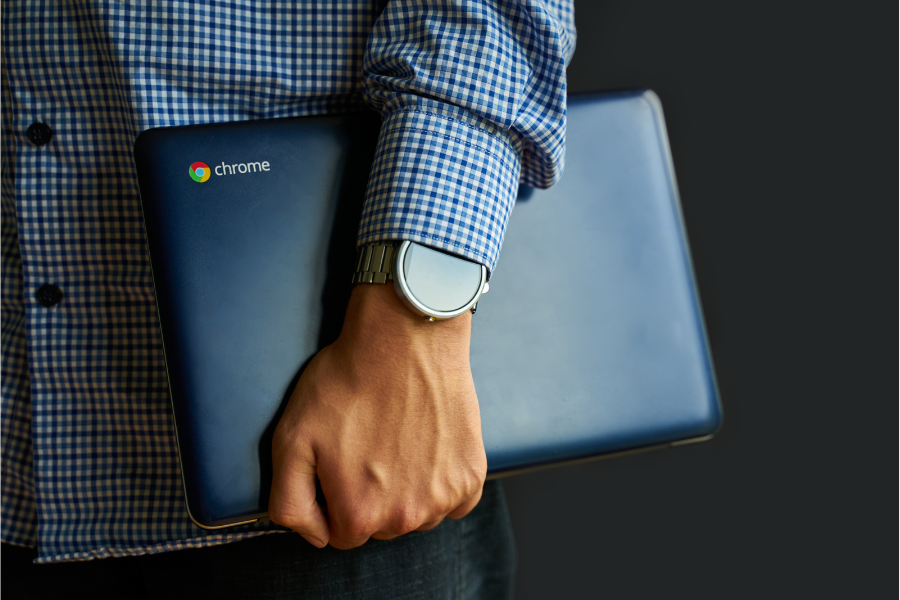
 A report from the U.S. Public Interest Research Group estimated that taxpayers could save $1.8 billion on Chromebooks for schools if the devices’ lifespans were doubled. | Konstantin Savusia/Shutterstock[/caption]
The U.S. Public Interest Research Group Education Fund says Google needs to extend the software expiration date of its Chromebooks.
"None of us can afford to stay on the disposability treadmill. All tech should last longer, and Google can lead the way by fixing the Chromebook Churn," a press release noted.
The Public Interest Research Group (PIRG) is a liberal NGO focused on consumer protection, public health and transportation.
A report from PIRG found three main problems that contribute to high turnover: Google’s Chromebook design choices make repair and reuse difficult, manufacturers typically do not sell new spare parts for repairs and the devices have a built-in software expiration date of about four years.
Chromebooks exploded in popularity for K-12 schools in particular during the COVID-19 pandemic, often bought with taxpayer dollars.
"Now, some three years after that huge spike in Chromebook sales - over 31 million units sold in that first year of the pandemic - schools are beginning to see their Chromebook fleets fail. This is the dark side to Chromebooks," the report stated.
The report estimated that across the 48.1 million K-12 public school students in the U.S., doubling the lifespan of Chromebooks could result in $1.8 billion dollars in savings for taxpayers, assuming no additional maintenance costs.
"We expect milk to expire, but not laptops," the press release stated, adding that once laptops expire they can't access secure websites such as online state testing sites.
A report from the U.S. Public Interest Research Group estimated that taxpayers could save $1.8 billion on Chromebooks for schools if the devices’ lifespans were doubled. | Konstantin Savusia/Shutterstock[/caption]
The U.S. Public Interest Research Group Education Fund says Google needs to extend the software expiration date of its Chromebooks.
"None of us can afford to stay on the disposability treadmill. All tech should last longer, and Google can lead the way by fixing the Chromebook Churn," a press release noted.
The Public Interest Research Group (PIRG) is a liberal NGO focused on consumer protection, public health and transportation.
A report from PIRG found three main problems that contribute to high turnover: Google’s Chromebook design choices make repair and reuse difficult, manufacturers typically do not sell new spare parts for repairs and the devices have a built-in software expiration date of about four years.
Chromebooks exploded in popularity for K-12 schools in particular during the COVID-19 pandemic, often bought with taxpayer dollars.
"Now, some three years after that huge spike in Chromebook sales - over 31 million units sold in that first year of the pandemic - schools are beginning to see their Chromebook fleets fail. This is the dark side to Chromebooks," the report stated.
The report estimated that across the 48.1 million K-12 public school students in the U.S., doubling the lifespan of Chromebooks could result in $1.8 billion dollars in savings for taxpayers, assuming no additional maintenance costs.
"We expect milk to expire, but not laptops," the press release stated, adding that once laptops expire they can't access secure websites such as online state testing sites.
[caption id="attachment_21765" align="aligncenter" width="900"] A report from the U.S. Public Interest Research Group estimated that taxpayers could save $1.8 billion on Chromebooks for schools if the devices’ lifespans were doubled. | Konstantin Savusia/Shutterstock[/caption]
The U.S. Public Interest Research Group Education Fund says Google needs to extend the software expiration date of its Chromebooks.
"None of us can afford to stay on the disposability treadmill. All tech should last longer, and Google can lead the way by fixing the Chromebook Churn," a press release noted.
The Public Interest Research Group (PIRG) is a liberal NGO focused on consumer protection, public health and transportation.
A report from PIRG found three main problems that contribute to high turnover: Google’s Chromebook design choices make repair and reuse difficult, manufacturers typically do not sell new spare parts for repairs and the devices have a built-in software expiration date of about four years.
Chromebooks exploded in popularity for K-12 schools in particular during the COVID-19 pandemic, often bought with taxpayer dollars.
"Now, some three years after that huge spike in Chromebook sales - over 31 million units sold in that first year of the pandemic - schools are beginning to see their Chromebook fleets fail. This is the dark side to Chromebooks," the report stated.
The report estimated that across the 48.1 million K-12 public school students in the U.S., doubling the lifespan of Chromebooks could result in $1.8 billion dollars in savings for taxpayers, assuming no additional maintenance costs.
"We expect milk to expire, but not laptops," the press release stated, adding that once laptops expire they can't access secure websites such as online state testing sites.
A report from the U.S. Public Interest Research Group estimated that taxpayers could save $1.8 billion on Chromebooks for schools if the devices’ lifespans were doubled. | Konstantin Savusia/Shutterstock[/caption]
The U.S. Public Interest Research Group Education Fund says Google needs to extend the software expiration date of its Chromebooks.
"None of us can afford to stay on the disposability treadmill. All tech should last longer, and Google can lead the way by fixing the Chromebook Churn," a press release noted.
The Public Interest Research Group (PIRG) is a liberal NGO focused on consumer protection, public health and transportation.
A report from PIRG found three main problems that contribute to high turnover: Google’s Chromebook design choices make repair and reuse difficult, manufacturers typically do not sell new spare parts for repairs and the devices have a built-in software expiration date of about four years.
Chromebooks exploded in popularity for K-12 schools in particular during the COVID-19 pandemic, often bought with taxpayer dollars.
"Now, some three years after that huge spike in Chromebook sales - over 31 million units sold in that first year of the pandemic - schools are beginning to see their Chromebook fleets fail. This is the dark side to Chromebooks," the report stated.
The report estimated that across the 48.1 million K-12 public school students in the U.S., doubling the lifespan of Chromebooks could result in $1.8 billion dollars in savings for taxpayers, assuming no additional maintenance costs.
"We expect milk to expire, but not laptops," the press release stated, adding that once laptops expire they can't access secure websites such as online state testing sites.
Categories