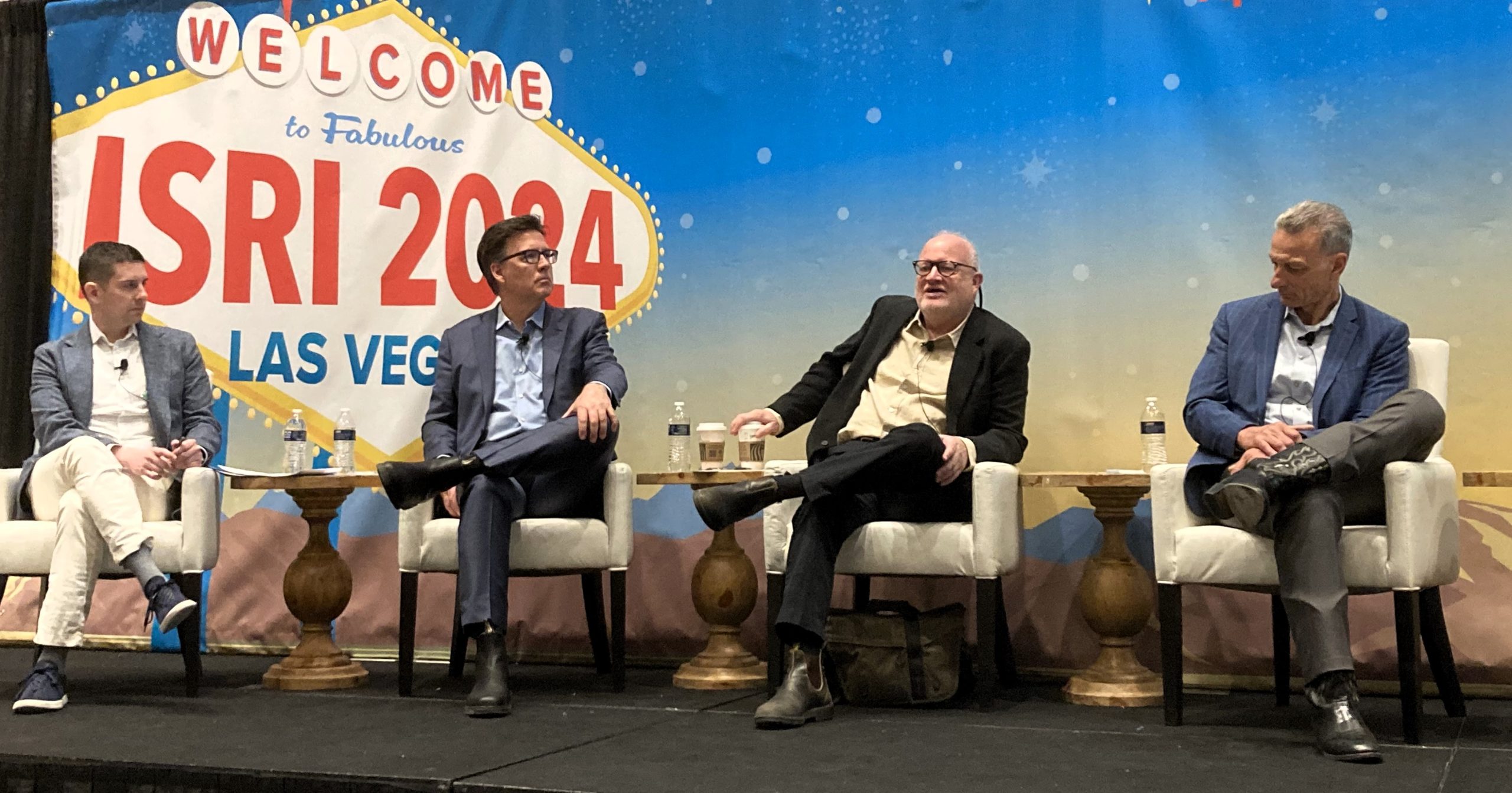
 An ISRI2024 session discussing the Basel Convention featured (from left) Adam Shaffer of ReMA, Paul Hagen of Beveridge & Diamond, Jim Puckett of the Basel Action Network and Craig Boswell of HOBI International. | Colin Staub/Resource Recycling[/caption]
In just under eight months, U.S. e-scrap companies looking to export end-of-life devices will face a dramatically different regulatory landscape that, under some readings, will prohibit the movement of most e-scrap materials from the U.S. to the vast majority of foreign countries.
The Basel Convention, a global agreement that's been ratified by 191 countries, lays out regulations on the movement of end-of-life materials. Party countries agree to adopt these regulations within their domestic laws. Although most countries in the world are party to the Convention, the U.S. is a notable exception.
Long focused specifically on hazardous materials, the Convention has historically been a vehicle to prevent wealthier nations from dumping waste materials in poorer countries. But in the last few years, the amendments to the Convention have taken on a more broadly environmental goal. Most notably, in 2019, party countries approved a change that added mixed scrap plastics into the Convention's purview with a stated goal of reducing plastic entering marine environments.
"It really has become the de facto agreement for the circular economy," said Paul Hagen, an attorney with Beveridge & Diamond and a longtime Basel expert, speaking during a panel at the ISRI2024 conference in Las Vegas last month.
Next January, another significant change along those same lines will come into effect: A wide range of end-of-life electronics will be covered by Basel regulations, largely prohibiting U.S. companies from shipping these materials overseas. The changes were approved by Basel party nations in 2022.
Hagen discussed the changes alongside Jim Puckett, executive director of the Basel Action Network, and Craig Boswell, president of HOBI International. The session was organized by the electronics division of ISRI, which rebranded during the conference and unveiled its new name, ReMA, the Recycled Materials Association. Adam Shaffer, ReMA's assistant vice president of international trade and global affairs, moderated the session.
An ISRI2024 session discussing the Basel Convention featured (from left) Adam Shaffer of ReMA, Paul Hagen of Beveridge & Diamond, Jim Puckett of the Basel Action Network and Craig Boswell of HOBI International. | Colin Staub/Resource Recycling[/caption]
In just under eight months, U.S. e-scrap companies looking to export end-of-life devices will face a dramatically different regulatory landscape that, under some readings, will prohibit the movement of most e-scrap materials from the U.S. to the vast majority of foreign countries.
The Basel Convention, a global agreement that's been ratified by 191 countries, lays out regulations on the movement of end-of-life materials. Party countries agree to adopt these regulations within their domestic laws. Although most countries in the world are party to the Convention, the U.S. is a notable exception.
Long focused specifically on hazardous materials, the Convention has historically been a vehicle to prevent wealthier nations from dumping waste materials in poorer countries. But in the last few years, the amendments to the Convention have taken on a more broadly environmental goal. Most notably, in 2019, party countries approved a change that added mixed scrap plastics into the Convention's purview with a stated goal of reducing plastic entering marine environments.
"It really has become the de facto agreement for the circular economy," said Paul Hagen, an attorney with Beveridge & Diamond and a longtime Basel expert, speaking during a panel at the ISRI2024 conference in Las Vegas last month.
Next January, another significant change along those same lines will come into effect: A wide range of end-of-life electronics will be covered by Basel regulations, largely prohibiting U.S. companies from shipping these materials overseas. The changes were approved by Basel party nations in 2022.
Hagen discussed the changes alongside Jim Puckett, executive director of the Basel Action Network, and Craig Boswell, president of HOBI International. The session was organized by the electronics division of ISRI, which rebranded during the conference and unveiled its new name, ReMA, the Recycled Materials Association. Adam Shaffer, ReMA's assistant vice president of international trade and global affairs, moderated the session.
[caption id="attachment_24413" align="aligncenter" width="2560"] An ISRI2024 session discussing the Basel Convention featured (from left) Adam Shaffer of ReMA, Paul Hagen of Beveridge & Diamond, Jim Puckett of the Basel Action Network and Craig Boswell of HOBI International. | Colin Staub/Resource Recycling[/caption]
In just under eight months, U.S. e-scrap companies looking to export end-of-life devices will face a dramatically different regulatory landscape that, under some readings, will prohibit the movement of most e-scrap materials from the U.S. to the vast majority of foreign countries.
The Basel Convention, a global agreement that's been ratified by 191 countries, lays out regulations on the movement of end-of-life materials. Party countries agree to adopt these regulations within their domestic laws. Although most countries in the world are party to the Convention, the U.S. is a notable exception.
Long focused specifically on hazardous materials, the Convention has historically been a vehicle to prevent wealthier nations from dumping waste materials in poorer countries. But in the last few years, the amendments to the Convention have taken on a more broadly environmental goal. Most notably, in 2019, party countries approved a change that added mixed scrap plastics into the Convention's purview with a stated goal of reducing plastic entering marine environments.
"It really has become the de facto agreement for the circular economy," said Paul Hagen, an attorney with Beveridge & Diamond and a longtime Basel expert, speaking during a panel at the ISRI2024 conference in Las Vegas last month.
Next January, another significant change along those same lines will come into effect: A wide range of end-of-life electronics will be covered by Basel regulations, largely prohibiting U.S. companies from shipping these materials overseas. The changes were approved by Basel party nations in 2022.
Hagen discussed the changes alongside Jim Puckett, executive director of the Basel Action Network, and Craig Boswell, president of HOBI International. The session was organized by the electronics division of ISRI, which rebranded during the conference and unveiled its new name, ReMA, the Recycled Materials Association. Adam Shaffer, ReMA's assistant vice president of international trade and global affairs, moderated the session.
An ISRI2024 session discussing the Basel Convention featured (from left) Adam Shaffer of ReMA, Paul Hagen of Beveridge & Diamond, Jim Puckett of the Basel Action Network and Craig Boswell of HOBI International. | Colin Staub/Resource Recycling[/caption]
In just under eight months, U.S. e-scrap companies looking to export end-of-life devices will face a dramatically different regulatory landscape that, under some readings, will prohibit the movement of most e-scrap materials from the U.S. to the vast majority of foreign countries.
The Basel Convention, a global agreement that's been ratified by 191 countries, lays out regulations on the movement of end-of-life materials. Party countries agree to adopt these regulations within their domestic laws. Although most countries in the world are party to the Convention, the U.S. is a notable exception.
Long focused specifically on hazardous materials, the Convention has historically been a vehicle to prevent wealthier nations from dumping waste materials in poorer countries. But in the last few years, the amendments to the Convention have taken on a more broadly environmental goal. Most notably, in 2019, party countries approved a change that added mixed scrap plastics into the Convention's purview with a stated goal of reducing plastic entering marine environments.
"It really has become the de facto agreement for the circular economy," said Paul Hagen, an attorney with Beveridge & Diamond and a longtime Basel expert, speaking during a panel at the ISRI2024 conference in Las Vegas last month.
Next January, another significant change along those same lines will come into effect: A wide range of end-of-life electronics will be covered by Basel regulations, largely prohibiting U.S. companies from shipping these materials overseas. The changes were approved by Basel party nations in 2022.
Hagen discussed the changes alongside Jim Puckett, executive director of the Basel Action Network, and Craig Boswell, president of HOBI International. The session was organized by the electronics division of ISRI, which rebranded during the conference and unveiled its new name, ReMA, the Recycled Materials Association. Adam Shaffer, ReMA's assistant vice president of international trade and global affairs, moderated the session.
Categories