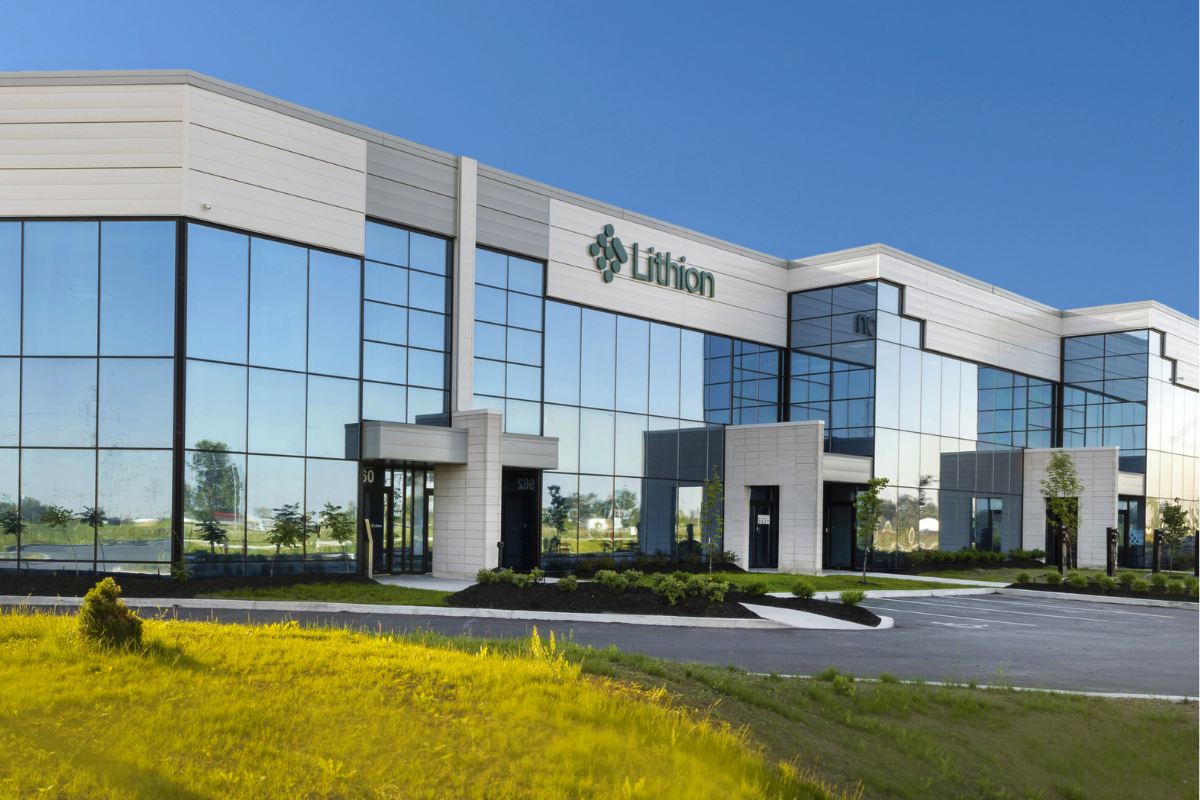
 Lithion Technologies' first commercial lithium-ion battery recycling facility in Saint-Bruno-de-Montarville, Canada. | Courtesy of Lithion Technologies[/caption]
A Quebec-area startup has brought its first commercial lithium-ion battery recycling facility online in Canada and plans to open up shop in the U.S. very soon.
Lithion Technologies is targeting a gap in the current lithium-ion battery recycling system, Benoit Couture, company president, told E-Scrap News. There's plenty of companies refining black mass into pCAM and CAM – and many are long-time players in the space, he said, so "they are very good, they're very strong, they're very powerful and they invest a lot in R&D."
"As a startup, saying we will be better than them – okay, it's good to have ambition, but let's make sure you have a good chance to establish yourself in the market," Couture said. "Take the position that is there."
On that philosophy, the battery producers will be Lithion Technologies's clients, Couture said, and will receive the black mass or individual refined strategic materials his company produces. Black mass contains strategic materials such as lithium, nickel, cobalt, manganese and graphite.
The Saint Bruno facility, which just opened in Saint-Bruno-de-Montarville near Montreal, will be one spoke in a future hub-and-spoke system. Under this model, companies typically do initial processing at "spoke" facilities and then send the material to a "hub" center for further refinement.
Lithion's spoke facility will take batteries and use a wet-shredding method to separate the black mass from the other battery components. The rest of the battery component material – aluminum, copper, steel and plastic – will be sent to other local recyclers. Couture said while there are strong markets for the metals, the plastic remains a challenge.
"It's very easy to find a solution to sell the copper, the aluminum and steel. Very easy, a very good value," he said. "But for the plastic, it depends on who's active around us. It won't travel very easily. For plastic, the value is not there."
The black mass will eventually go to the hub facility, which the company will build next, to separate out the strategic materials further. It is currently selecting a site.
Couture said the Saint Bruno facility is "ready to serve the market." It had about 400 metric tons of batteries at the site the day it opened. Annually, it has a capacity of 10,000 tons of input material, with the ability to easily scale up to 20,000 tons.
Most of the spoke facilities will be around that size, he added, as it's the sweet spot to take both EV battery production scrap, end-of-life EV batteries and whatever other smaller lithium-ion batteries are nearby.
Lithion Technologies's main focus is EV batteries, both production scrap and end-of-life batteries, and it has signed several strategic agreements with electric vehicle manufacturers, including GM. It will also take smaller batteries from consumer electronics, Couture said, but the economics work out easier with the larger EV batteries.
"We can recycle it, but you don't build a plant for those batteries because the capacity is very low," he said. "We serve the market, we take the batteries, we recycle them with a very sustainable solution. But you won't build a plant for the laptop batteries."
The technology was designed to be both battery chemistry agnostic and low-emission, Couture said, because the intention is to site the facilities near urban areas to tap into the "urban mine."
"We designed the technology having in mind we're not taking care of the waste, we are exploiting the urban mine," he said. "So we designed it to be very efficient. To put our hands on all the valuable material and maximize it."
And to be sited near urban areas, "you have to be very clean, a very good neighbor," Couture added. "So we designed our plant to be a good neighbor."
Lithion Technologies' first commercial lithium-ion battery recycling facility in Saint-Bruno-de-Montarville, Canada. | Courtesy of Lithion Technologies[/caption]
A Quebec-area startup has brought its first commercial lithium-ion battery recycling facility online in Canada and plans to open up shop in the U.S. very soon.
Lithion Technologies is targeting a gap in the current lithium-ion battery recycling system, Benoit Couture, company president, told E-Scrap News. There's plenty of companies refining black mass into pCAM and CAM – and many are long-time players in the space, he said, so "they are very good, they're very strong, they're very powerful and they invest a lot in R&D."
"As a startup, saying we will be better than them – okay, it's good to have ambition, but let's make sure you have a good chance to establish yourself in the market," Couture said. "Take the position that is there."
On that philosophy, the battery producers will be Lithion Technologies's clients, Couture said, and will receive the black mass or individual refined strategic materials his company produces. Black mass contains strategic materials such as lithium, nickel, cobalt, manganese and graphite.
The Saint Bruno facility, which just opened in Saint-Bruno-de-Montarville near Montreal, will be one spoke in a future hub-and-spoke system. Under this model, companies typically do initial processing at "spoke" facilities and then send the material to a "hub" center for further refinement.
Lithion's spoke facility will take batteries and use a wet-shredding method to separate the black mass from the other battery components. The rest of the battery component material – aluminum, copper, steel and plastic – will be sent to other local recyclers. Couture said while there are strong markets for the metals, the plastic remains a challenge.
"It's very easy to find a solution to sell the copper, the aluminum and steel. Very easy, a very good value," he said. "But for the plastic, it depends on who's active around us. It won't travel very easily. For plastic, the value is not there."
The black mass will eventually go to the hub facility, which the company will build next, to separate out the strategic materials further. It is currently selecting a site.
Couture said the Saint Bruno facility is "ready to serve the market." It had about 400 metric tons of batteries at the site the day it opened. Annually, it has a capacity of 10,000 tons of input material, with the ability to easily scale up to 20,000 tons.
Most of the spoke facilities will be around that size, he added, as it's the sweet spot to take both EV battery production scrap, end-of-life EV batteries and whatever other smaller lithium-ion batteries are nearby.
Lithion Technologies's main focus is EV batteries, both production scrap and end-of-life batteries, and it has signed several strategic agreements with electric vehicle manufacturers, including GM. It will also take smaller batteries from consumer electronics, Couture said, but the economics work out easier with the larger EV batteries.
"We can recycle it, but you don't build a plant for those batteries because the capacity is very low," he said. "We serve the market, we take the batteries, we recycle them with a very sustainable solution. But you won't build a plant for the laptop batteries."
The technology was designed to be both battery chemistry agnostic and low-emission, Couture said, because the intention is to site the facilities near urban areas to tap into the "urban mine."
"We designed the technology having in mind we're not taking care of the waste, we are exploiting the urban mine," he said. "So we designed it to be very efficient. To put our hands on all the valuable material and maximize it."
And to be sited near urban areas, "you have to be very clean, a very good neighbor," Couture added. "So we designed our plant to be a good neighbor."
[caption id="attachment_24537" align="aligncenter" width="1200"] Lithion Technologies' first commercial lithium-ion battery recycling facility in Saint-Bruno-de-Montarville, Canada. | Courtesy of Lithion Technologies[/caption]
A Quebec-area startup has brought its first commercial lithium-ion battery recycling facility online in Canada and plans to open up shop in the U.S. very soon.
Lithion Technologies is targeting a gap in the current lithium-ion battery recycling system, Benoit Couture, company president, told E-Scrap News. There's plenty of companies refining black mass into pCAM and CAM – and many are long-time players in the space, he said, so "they are very good, they're very strong, they're very powerful and they invest a lot in R&D."
"As a startup, saying we will be better than them – okay, it's good to have ambition, but let's make sure you have a good chance to establish yourself in the market," Couture said. "Take the position that is there."
On that philosophy, the battery producers will be Lithion Technologies's clients, Couture said, and will receive the black mass or individual refined strategic materials his company produces. Black mass contains strategic materials such as lithium, nickel, cobalt, manganese and graphite.
The Saint Bruno facility, which just opened in Saint-Bruno-de-Montarville near Montreal, will be one spoke in a future hub-and-spoke system. Under this model, companies typically do initial processing at "spoke" facilities and then send the material to a "hub" center for further refinement.
Lithion's spoke facility will take batteries and use a wet-shredding method to separate the black mass from the other battery components. The rest of the battery component material – aluminum, copper, steel and plastic – will be sent to other local recyclers. Couture said while there are strong markets for the metals, the plastic remains a challenge.
"It's very easy to find a solution to sell the copper, the aluminum and steel. Very easy, a very good value," he said. "But for the plastic, it depends on who's active around us. It won't travel very easily. For plastic, the value is not there."
The black mass will eventually go to the hub facility, which the company will build next, to separate out the strategic materials further. It is currently selecting a site.
Couture said the Saint Bruno facility is "ready to serve the market." It had about 400 metric tons of batteries at the site the day it opened. Annually, it has a capacity of 10,000 tons of input material, with the ability to easily scale up to 20,000 tons.
Most of the spoke facilities will be around that size, he added, as it's the sweet spot to take both EV battery production scrap, end-of-life EV batteries and whatever other smaller lithium-ion batteries are nearby.
Lithion Technologies's main focus is EV batteries, both production scrap and end-of-life batteries, and it has signed several strategic agreements with electric vehicle manufacturers, including GM. It will also take smaller batteries from consumer electronics, Couture said, but the economics work out easier with the larger EV batteries.
"We can recycle it, but you don't build a plant for those batteries because the capacity is very low," he said. "We serve the market, we take the batteries, we recycle them with a very sustainable solution. But you won't build a plant for the laptop batteries."
The technology was designed to be both battery chemistry agnostic and low-emission, Couture said, because the intention is to site the facilities near urban areas to tap into the "urban mine."
"We designed the technology having in mind we're not taking care of the waste, we are exploiting the urban mine," he said. "So we designed it to be very efficient. To put our hands on all the valuable material and maximize it."
And to be sited near urban areas, "you have to be very clean, a very good neighbor," Couture added. "So we designed our plant to be a good neighbor."
Lithion Technologies' first commercial lithium-ion battery recycling facility in Saint-Bruno-de-Montarville, Canada. | Courtesy of Lithion Technologies[/caption]
A Quebec-area startup has brought its first commercial lithium-ion battery recycling facility online in Canada and plans to open up shop in the U.S. very soon.
Lithion Technologies is targeting a gap in the current lithium-ion battery recycling system, Benoit Couture, company president, told E-Scrap News. There's plenty of companies refining black mass into pCAM and CAM – and many are long-time players in the space, he said, so "they are very good, they're very strong, they're very powerful and they invest a lot in R&D."
"As a startup, saying we will be better than them – okay, it's good to have ambition, but let's make sure you have a good chance to establish yourself in the market," Couture said. "Take the position that is there."
On that philosophy, the battery producers will be Lithion Technologies's clients, Couture said, and will receive the black mass or individual refined strategic materials his company produces. Black mass contains strategic materials such as lithium, nickel, cobalt, manganese and graphite.
The Saint Bruno facility, which just opened in Saint-Bruno-de-Montarville near Montreal, will be one spoke in a future hub-and-spoke system. Under this model, companies typically do initial processing at "spoke" facilities and then send the material to a "hub" center for further refinement.
Lithion's spoke facility will take batteries and use a wet-shredding method to separate the black mass from the other battery components. The rest of the battery component material – aluminum, copper, steel and plastic – will be sent to other local recyclers. Couture said while there are strong markets for the metals, the plastic remains a challenge.
"It's very easy to find a solution to sell the copper, the aluminum and steel. Very easy, a very good value," he said. "But for the plastic, it depends on who's active around us. It won't travel very easily. For plastic, the value is not there."
The black mass will eventually go to the hub facility, which the company will build next, to separate out the strategic materials further. It is currently selecting a site.
Couture said the Saint Bruno facility is "ready to serve the market." It had about 400 metric tons of batteries at the site the day it opened. Annually, it has a capacity of 10,000 tons of input material, with the ability to easily scale up to 20,000 tons.
Most of the spoke facilities will be around that size, he added, as it's the sweet spot to take both EV battery production scrap, end-of-life EV batteries and whatever other smaller lithium-ion batteries are nearby.
Lithion Technologies's main focus is EV batteries, both production scrap and end-of-life batteries, and it has signed several strategic agreements with electric vehicle manufacturers, including GM. It will also take smaller batteries from consumer electronics, Couture said, but the economics work out easier with the larger EV batteries.
"We can recycle it, but you don't build a plant for those batteries because the capacity is very low," he said. "We serve the market, we take the batteries, we recycle them with a very sustainable solution. But you won't build a plant for the laptop batteries."
The technology was designed to be both battery chemistry agnostic and low-emission, Couture said, because the intention is to site the facilities near urban areas to tap into the "urban mine."
"We designed the technology having in mind we're not taking care of the waste, we are exploiting the urban mine," he said. "So we designed it to be very efficient. To put our hands on all the valuable material and maximize it."
And to be sited near urban areas, "you have to be very clean, a very good neighbor," Couture added. "So we designed our plant to be a good neighbor."
Categories