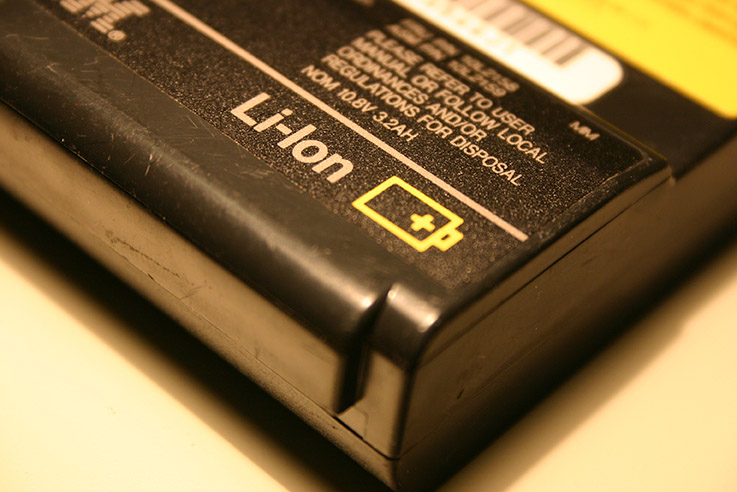
 Regulators are looking at lithium-ion battery labeling requirements, but improper collection of the batteries is just one of their recycling challenges. | Allyson Kitts/Shutterstock[/caption]
California officials are considering regulating lithium-ion battery labels, but an e-scrap processor says they're missing a bigger issue: Battery-containing electronics are increasingly expensive to process.
Lithium-ion battery fires have caused millions of dollars in damage for residential recycling facilities, and this problem has received wider public attention in the past couple years. In California, the issue led the California Department of Resources Recycling and Recovery (CalRecycle) to explore labeling requirements to ensure the products do not end up in the municipal recycling stream.
Routing battery-containing devices away from the municipal stream and toward the electronics recycling sector would go a long way toward reducing fires at materials recovery facilities (MRFs), CalRecycle explained during a workshop last week.
"We recognize that labeling is a small piece of the puzzle to decreasing fires, increasing battery collection and recycling, and benefiting public health and environment," said Frederick Thomas, a senior environmental scientist with CalRecycle. "The question is how to make labeling as effective as possible in this regard."
But during the workshop, e-scrap companies and other recycling stakeholders noted the problem extends beyond just getting batteries to the right type of facility.
"The bigger question is handling these batteries," said Dennis Kazarian, vice president of Paramount, Calif.-headquartered e-Recycling of California. "These are a growing, growing concern in our industry."
The cost to disassemble and recycle lithium-ion battery-bearing products is becoming prohibitive, he said, and it's getting worse. The costs to consumers or collectors delivering lithium-ion battery products to e-scrap firms are beginning to rise, he said. When those costs reach a certain point, it won't make financial sense for the consumer to properly recycle those products.
"If you don't start thinking about what it costs us to take apart these batteries, you can forget this rule altogether, because these batteries are going to go right into the street or they're going to go right into the landfill," he said.
Ultimately, he said the key issue with lithium-ion batteries is determining who is going to pay for the cost of processing them.
"You can't be talking about recycling without understanding what the heck is going to happen to it at the end: Where is the end product? What's going to happen to it? How are you going to handle it? What's the cost of that? Who's going to pay for that?" Kazarian said.
The fire hazard extends to e-scrap facilities, as well. Processors last year shared tips on avoiding "thermal events," meaning fires or explosions caused by lithium-ion batteries that retain residual charge.
CalRecycle staff reassured that the agency understands this concern with the lithium-ion battery stream.
"We realize this is a huge problem, and we're not saying that [labeling] is going to solve everything," said Teresa Bui, a CalRecycle special adviser who used to work for environmental advocacy group Californians Against Waste. "This is a very small part of the puzzle."
Regulators are looking at lithium-ion battery labeling requirements, but improper collection of the batteries is just one of their recycling challenges. | Allyson Kitts/Shutterstock[/caption]
California officials are considering regulating lithium-ion battery labels, but an e-scrap processor says they're missing a bigger issue: Battery-containing electronics are increasingly expensive to process.
Lithium-ion battery fires have caused millions of dollars in damage for residential recycling facilities, and this problem has received wider public attention in the past couple years. In California, the issue led the California Department of Resources Recycling and Recovery (CalRecycle) to explore labeling requirements to ensure the products do not end up in the municipal recycling stream.
Routing battery-containing devices away from the municipal stream and toward the electronics recycling sector would go a long way toward reducing fires at materials recovery facilities (MRFs), CalRecycle explained during a workshop last week.
"We recognize that labeling is a small piece of the puzzle to decreasing fires, increasing battery collection and recycling, and benefiting public health and environment," said Frederick Thomas, a senior environmental scientist with CalRecycle. "The question is how to make labeling as effective as possible in this regard."
But during the workshop, e-scrap companies and other recycling stakeholders noted the problem extends beyond just getting batteries to the right type of facility.
"The bigger question is handling these batteries," said Dennis Kazarian, vice president of Paramount, Calif.-headquartered e-Recycling of California. "These are a growing, growing concern in our industry."
The cost to disassemble and recycle lithium-ion battery-bearing products is becoming prohibitive, he said, and it's getting worse. The costs to consumers or collectors delivering lithium-ion battery products to e-scrap firms are beginning to rise, he said. When those costs reach a certain point, it won't make financial sense for the consumer to properly recycle those products.
"If you don't start thinking about what it costs us to take apart these batteries, you can forget this rule altogether, because these batteries are going to go right into the street or they're going to go right into the landfill," he said.
Ultimately, he said the key issue with lithium-ion batteries is determining who is going to pay for the cost of processing them.
"You can't be talking about recycling without understanding what the heck is going to happen to it at the end: Where is the end product? What's going to happen to it? How are you going to handle it? What's the cost of that? Who's going to pay for that?" Kazarian said.
The fire hazard extends to e-scrap facilities, as well. Processors last year shared tips on avoiding "thermal events," meaning fires or explosions caused by lithium-ion batteries that retain residual charge.
CalRecycle staff reassured that the agency understands this concern with the lithium-ion battery stream.
"We realize this is a huge problem, and we're not saying that [labeling] is going to solve everything," said Teresa Bui, a CalRecycle special adviser who used to work for environmental advocacy group Californians Against Waste. "This is a very small part of the puzzle."
[caption id="attachment_10008" align="aligncenter" width="737"] Regulators are looking at lithium-ion battery labeling requirements, but improper collection of the batteries is just one of their recycling challenges. | Allyson Kitts/Shutterstock[/caption]
California officials are considering regulating lithium-ion battery labels, but an e-scrap processor says they're missing a bigger issue: Battery-containing electronics are increasingly expensive to process.
Lithium-ion battery fires have caused millions of dollars in damage for residential recycling facilities, and this problem has received wider public attention in the past couple years. In California, the issue led the California Department of Resources Recycling and Recovery (CalRecycle) to explore labeling requirements to ensure the products do not end up in the municipal recycling stream.
Routing battery-containing devices away from the municipal stream and toward the electronics recycling sector would go a long way toward reducing fires at materials recovery facilities (MRFs), CalRecycle explained during a workshop last week.
"We recognize that labeling is a small piece of the puzzle to decreasing fires, increasing battery collection and recycling, and benefiting public health and environment," said Frederick Thomas, a senior environmental scientist with CalRecycle. "The question is how to make labeling as effective as possible in this regard."
But during the workshop, e-scrap companies and other recycling stakeholders noted the problem extends beyond just getting batteries to the right type of facility.
"The bigger question is handling these batteries," said Dennis Kazarian, vice president of Paramount, Calif.-headquartered e-Recycling of California. "These are a growing, growing concern in our industry."
The cost to disassemble and recycle lithium-ion battery-bearing products is becoming prohibitive, he said, and it's getting worse. The costs to consumers or collectors delivering lithium-ion battery products to e-scrap firms are beginning to rise, he said. When those costs reach a certain point, it won't make financial sense for the consumer to properly recycle those products.
"If you don't start thinking about what it costs us to take apart these batteries, you can forget this rule altogether, because these batteries are going to go right into the street or they're going to go right into the landfill," he said.
Ultimately, he said the key issue with lithium-ion batteries is determining who is going to pay for the cost of processing them.
"You can't be talking about recycling without understanding what the heck is going to happen to it at the end: Where is the end product? What's going to happen to it? How are you going to handle it? What's the cost of that? Who's going to pay for that?" Kazarian said.
The fire hazard extends to e-scrap facilities, as well. Processors last year shared tips on avoiding "thermal events," meaning fires or explosions caused by lithium-ion batteries that retain residual charge.
CalRecycle staff reassured that the agency understands this concern with the lithium-ion battery stream.
"We realize this is a huge problem, and we're not saying that [labeling] is going to solve everything," said Teresa Bui, a CalRecycle special adviser who used to work for environmental advocacy group Californians Against Waste. "This is a very small part of the puzzle."
Regulators are looking at lithium-ion battery labeling requirements, but improper collection of the batteries is just one of their recycling challenges. | Allyson Kitts/Shutterstock[/caption]
California officials are considering regulating lithium-ion battery labels, but an e-scrap processor says they're missing a bigger issue: Battery-containing electronics are increasingly expensive to process.
Lithium-ion battery fires have caused millions of dollars in damage for residential recycling facilities, and this problem has received wider public attention in the past couple years. In California, the issue led the California Department of Resources Recycling and Recovery (CalRecycle) to explore labeling requirements to ensure the products do not end up in the municipal recycling stream.
Routing battery-containing devices away from the municipal stream and toward the electronics recycling sector would go a long way toward reducing fires at materials recovery facilities (MRFs), CalRecycle explained during a workshop last week.
"We recognize that labeling is a small piece of the puzzle to decreasing fires, increasing battery collection and recycling, and benefiting public health and environment," said Frederick Thomas, a senior environmental scientist with CalRecycle. "The question is how to make labeling as effective as possible in this regard."
But during the workshop, e-scrap companies and other recycling stakeholders noted the problem extends beyond just getting batteries to the right type of facility.
"The bigger question is handling these batteries," said Dennis Kazarian, vice president of Paramount, Calif.-headquartered e-Recycling of California. "These are a growing, growing concern in our industry."
The cost to disassemble and recycle lithium-ion battery-bearing products is becoming prohibitive, he said, and it's getting worse. The costs to consumers or collectors delivering lithium-ion battery products to e-scrap firms are beginning to rise, he said. When those costs reach a certain point, it won't make financial sense for the consumer to properly recycle those products.
"If you don't start thinking about what it costs us to take apart these batteries, you can forget this rule altogether, because these batteries are going to go right into the street or they're going to go right into the landfill," he said.
Ultimately, he said the key issue with lithium-ion batteries is determining who is going to pay for the cost of processing them.
"You can't be talking about recycling without understanding what the heck is going to happen to it at the end: Where is the end product? What's going to happen to it? How are you going to handle it? What's the cost of that? Who's going to pay for that?" Kazarian said.
The fire hazard extends to e-scrap facilities, as well. Processors last year shared tips on avoiding "thermal events," meaning fires or explosions caused by lithium-ion batteries that retain residual charge.
CalRecycle staff reassured that the agency understands this concern with the lithium-ion battery stream.
"We realize this is a huge problem, and we're not saying that [labeling] is going to solve everything," said Teresa Bui, a CalRecycle special adviser who used to work for environmental advocacy group Californians Against Waste. "This is a very small part of the puzzle."
Categories