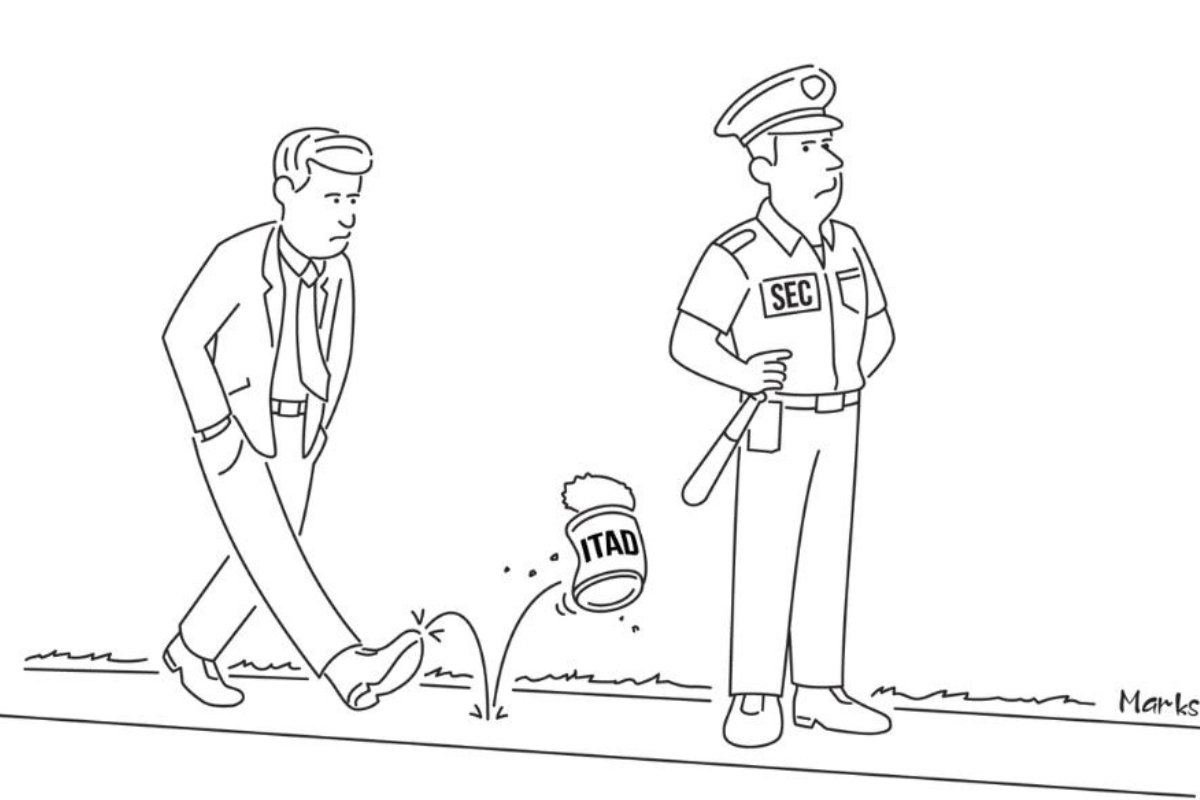
 Using lighthearted illustrations, the book details the risks of improper ITAD practices, including federal fines. | Kyle Marks[/caption]
Asset recovery industry veteran Kyle Marks recently published a book aimed at educating high-level corporate decision-makers about the importance of proper ITAD practices. The book takes what could be a dry subject for a non-expert audience and livens it up with illustrations.
Marks in March published "Where the IT Lifecycle Ends: How Non-Compliant IT Asset Disposition Creates Unnecessary Exposure," a short guide to proper ITAD management that goes beyond simply hiring a reputable vendor.
Marks, whose day job is running ITAD consulting firm Retire-IT, wrote the book with an intended audience of corporate officers working in governance, risk and compliance roles. It explores a point Marks has vocalized for years, including in web presentations where he regularly included the illustrations that laid the groundwork for the book. His central thesis is that major corporate enterprises should modernize their IT asset management practices, largely by building in greater accountability and minimizing a reliance on trust.
In an interview, Marks said he thinks there is a growing awareness among large companies of the importance of ITAD, but there are certain knowledge gaps.
"I think they're becoming much more aware of working with credible vendors," he said, "but they still don't understand the hidden risks."
The book hammers on those risks, which increasingly include huge fines from the federal government. The Morgan Stanley data breach that came to light in 2020, for example, has so far cost the company hundreds of millions of dollars in fines, and the Securities and Exchange Commission last year passed new cybersecurity rules that strengthen reporting requirements for data loss incidents.
Marks outlines an approach to avoiding such ITAD-related data loss incidents, focusing on segregation of duties, the use of disposal tags and equipment verification.
Broadly speaking, segregation of duties in this context means ensuring a company's asset disposition team is separate from its device acquisition department, reducing the possibility that asset loss could be covered up in an effort to avoid disclosure and fines. Disposal tags are a method of barcoding devices to track them during asset disposition. And equipment verification typically means a process of checking that what's received by an ITAD vendor matches what was removed from a client's office.
Using lighthearted illustrations, the book details the risks of improper ITAD practices, including federal fines. | Kyle Marks[/caption]
Asset recovery industry veteran Kyle Marks recently published a book aimed at educating high-level corporate decision-makers about the importance of proper ITAD practices. The book takes what could be a dry subject for a non-expert audience and livens it up with illustrations.
Marks in March published "Where the IT Lifecycle Ends: How Non-Compliant IT Asset Disposition Creates Unnecessary Exposure," a short guide to proper ITAD management that goes beyond simply hiring a reputable vendor.
Marks, whose day job is running ITAD consulting firm Retire-IT, wrote the book with an intended audience of corporate officers working in governance, risk and compliance roles. It explores a point Marks has vocalized for years, including in web presentations where he regularly included the illustrations that laid the groundwork for the book. His central thesis is that major corporate enterprises should modernize their IT asset management practices, largely by building in greater accountability and minimizing a reliance on trust.
In an interview, Marks said he thinks there is a growing awareness among large companies of the importance of ITAD, but there are certain knowledge gaps.
"I think they're becoming much more aware of working with credible vendors," he said, "but they still don't understand the hidden risks."
The book hammers on those risks, which increasingly include huge fines from the federal government. The Morgan Stanley data breach that came to light in 2020, for example, has so far cost the company hundreds of millions of dollars in fines, and the Securities and Exchange Commission last year passed new cybersecurity rules that strengthen reporting requirements for data loss incidents.
Marks outlines an approach to avoiding such ITAD-related data loss incidents, focusing on segregation of duties, the use of disposal tags and equipment verification.
Broadly speaking, segregation of duties in this context means ensuring a company's asset disposition team is separate from its device acquisition department, reducing the possibility that asset loss could be covered up in an effort to avoid disclosure and fines. Disposal tags are a method of barcoding devices to track them during asset disposition. And equipment verification typically means a process of checking that what's received by an ITAD vendor matches what was removed from a client's office.
[caption id="attachment_24288" align="aligncenter" width="1200"] Using lighthearted illustrations, the book details the risks of improper ITAD practices, including federal fines. | Kyle Marks[/caption]
Asset recovery industry veteran Kyle Marks recently published a book aimed at educating high-level corporate decision-makers about the importance of proper ITAD practices. The book takes what could be a dry subject for a non-expert audience and livens it up with illustrations.
Marks in March published "Where the IT Lifecycle Ends: How Non-Compliant IT Asset Disposition Creates Unnecessary Exposure," a short guide to proper ITAD management that goes beyond simply hiring a reputable vendor.
Marks, whose day job is running ITAD consulting firm Retire-IT, wrote the book with an intended audience of corporate officers working in governance, risk and compliance roles. It explores a point Marks has vocalized for years, including in web presentations where he regularly included the illustrations that laid the groundwork for the book. His central thesis is that major corporate enterprises should modernize their IT asset management practices, largely by building in greater accountability and minimizing a reliance on trust.
In an interview, Marks said he thinks there is a growing awareness among large companies of the importance of ITAD, but there are certain knowledge gaps.
"I think they're becoming much more aware of working with credible vendors," he said, "but they still don't understand the hidden risks."
The book hammers on those risks, which increasingly include huge fines from the federal government. The Morgan Stanley data breach that came to light in 2020, for example, has so far cost the company hundreds of millions of dollars in fines, and the Securities and Exchange Commission last year passed new cybersecurity rules that strengthen reporting requirements for data loss incidents.
Marks outlines an approach to avoiding such ITAD-related data loss incidents, focusing on segregation of duties, the use of disposal tags and equipment verification.
Broadly speaking, segregation of duties in this context means ensuring a company's asset disposition team is separate from its device acquisition department, reducing the possibility that asset loss could be covered up in an effort to avoid disclosure and fines. Disposal tags are a method of barcoding devices to track them during asset disposition. And equipment verification typically means a process of checking that what's received by an ITAD vendor matches what was removed from a client's office.
Using lighthearted illustrations, the book details the risks of improper ITAD practices, including federal fines. | Kyle Marks[/caption]
Asset recovery industry veteran Kyle Marks recently published a book aimed at educating high-level corporate decision-makers about the importance of proper ITAD practices. The book takes what could be a dry subject for a non-expert audience and livens it up with illustrations.
Marks in March published "Where the IT Lifecycle Ends: How Non-Compliant IT Asset Disposition Creates Unnecessary Exposure," a short guide to proper ITAD management that goes beyond simply hiring a reputable vendor.
Marks, whose day job is running ITAD consulting firm Retire-IT, wrote the book with an intended audience of corporate officers working in governance, risk and compliance roles. It explores a point Marks has vocalized for years, including in web presentations where he regularly included the illustrations that laid the groundwork for the book. His central thesis is that major corporate enterprises should modernize their IT asset management practices, largely by building in greater accountability and minimizing a reliance on trust.
In an interview, Marks said he thinks there is a growing awareness among large companies of the importance of ITAD, but there are certain knowledge gaps.
"I think they're becoming much more aware of working with credible vendors," he said, "but they still don't understand the hidden risks."
The book hammers on those risks, which increasingly include huge fines from the federal government. The Morgan Stanley data breach that came to light in 2020, for example, has so far cost the company hundreds of millions of dollars in fines, and the Securities and Exchange Commission last year passed new cybersecurity rules that strengthen reporting requirements for data loss incidents.
Marks outlines an approach to avoiding such ITAD-related data loss incidents, focusing on segregation of duties, the use of disposal tags and equipment verification.
Broadly speaking, segregation of duties in this context means ensuring a company's asset disposition team is separate from its device acquisition department, reducing the possibility that asset loss could be covered up in an effort to avoid disclosure and fines. Disposal tags are a method of barcoding devices to track them during asset disposition. And equipment verification typically means a process of checking that what's received by an ITAD vendor matches what was removed from a client's office.
Categories