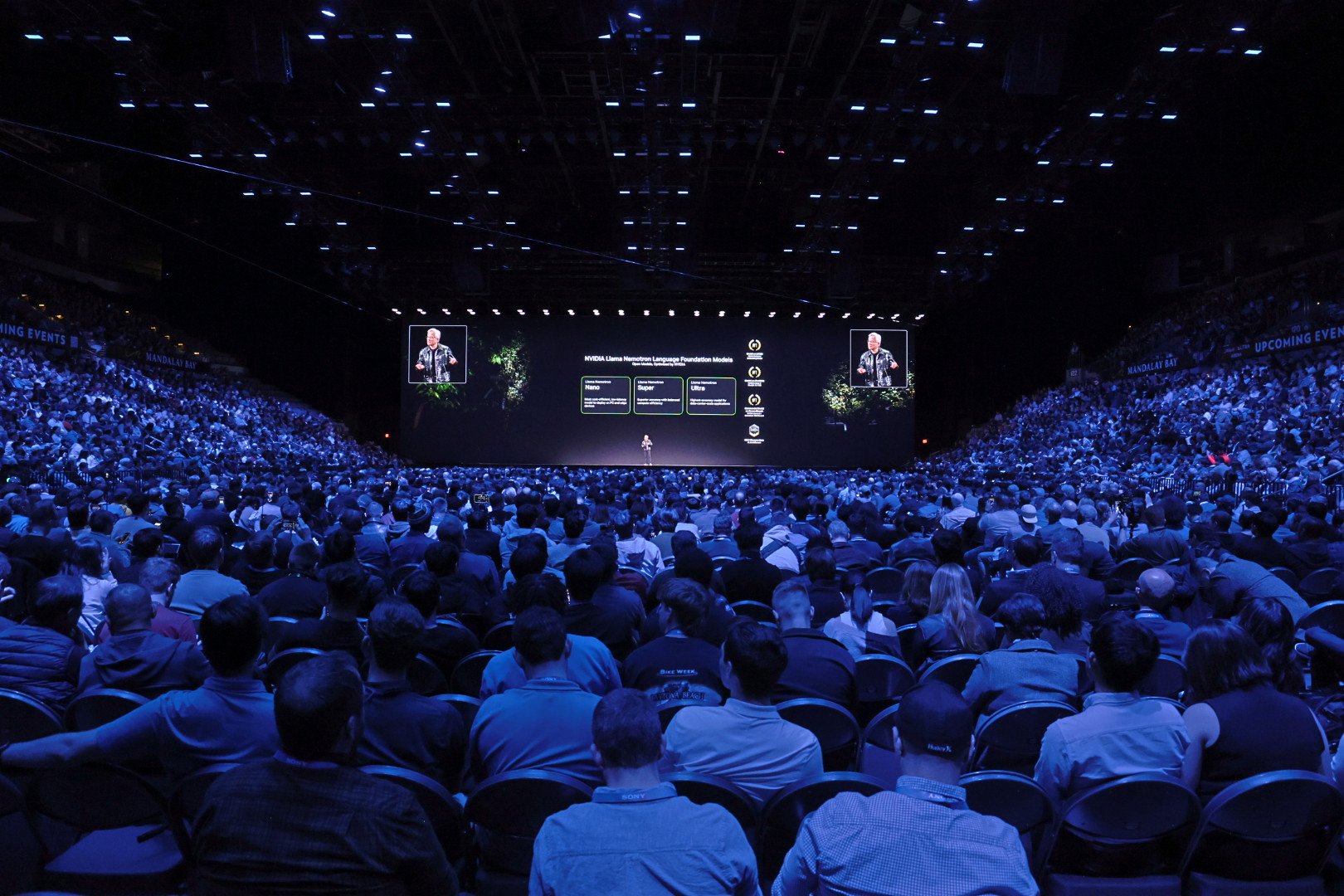
 Nvidia CEO Jensen Huang delivered a keynote address to a packed crowd on the opening night of CES 2025, held this week in Las Vegas. | Photo courtesy of the Consumer Technology Association[/caption]
Artificial intelligence and electric vehicles were major themes during the annual CES trade show this week, and panel discussions touched on the infrastructure – including hardware in data centers and battery recycling technology – that will be key to those segments' growth.
Each year, CES, hosted by the Consumer Technology Association, highlights current trends and the latest products in the consumer electronics market. The 2025 event was held this week in Las Vegas and was partly livestreamed.
Much of the AI-related discussion focused on new applications and which sectors could incorporate AI next. But a session featuring consulting firm Deloitte brought up the hardware that is required for the type of advanced computing that's associated with AI and other emerging technologies.
Bill Briggs, chief technology officer of Deloitte Consulting, modified a well-known, decade-old quote within the tech industry, "software is eating the world." Nowadays, Briggs said, it's hardware that's eating the world.
"We're at this interesting point where hardware matters again," Briggs said. "It was not a part of the conversation that I had with clients a lot in the last decade, at least compared to all of the discussion about digital, and data, and information."
The hardware requirements of data centers have increased in recent years, alongside prominent societal trends like remote work, cloud computing and the emergence of generative AI, which is heavily reliant on advanced graphics processing units.
"Cloud brought us to a point where we thought that hardware was just a commodity, and it was something we didn't have to think much about," Briggs said. But now there are "more and more CEO conversations about the investments needed to be made in hardware to fuel the tech trajectory that we know is coming in the next decade."
Those investments are closely tied to the ITAD market, because when companies invest to upgrade – such as outfitting data centers with the latest chipsets – they have to manage disposition of the retired equipment. When enterprises paused upgrades during and after the peak of the pandemic, the ITAD industry saw lower demand and component prices.
ITAD giants like Iron Mountain and SK Tes have drawn a clear link between the rise of AI and projected demand for ITAD. And recent research in the Nature Computational Science journal found that, without sound management strategies involving reuse and redeployment, the hardware requirements of AI and data centers will lead to a huge amount of additional electronics waste.
Beyond requiring refreshes to the latest technology, harnessing AI will require an overall larger data center footprint, which will mean more material to be handled by ITAD operators. This week, President-elect Donald Trump announced during a press conference that United Arab Emirates-based billionaire Hussain Sajwani will invest $20 billion in U.S. data center construction to support the hyperscale market.
The money will support "massive new data centers" across multiple regions of the U.S., Trump said, adding the data centers will "keep America on the cutting edge of technology and artificial intelligence."
Nvidia CEO Jensen Huang delivered a keynote address to a packed crowd on the opening night of CES 2025, held this week in Las Vegas. | Photo courtesy of the Consumer Technology Association[/caption]
Artificial intelligence and electric vehicles were major themes during the annual CES trade show this week, and panel discussions touched on the infrastructure – including hardware in data centers and battery recycling technology – that will be key to those segments' growth.
Each year, CES, hosted by the Consumer Technology Association, highlights current trends and the latest products in the consumer electronics market. The 2025 event was held this week in Las Vegas and was partly livestreamed.
Much of the AI-related discussion focused on new applications and which sectors could incorporate AI next. But a session featuring consulting firm Deloitte brought up the hardware that is required for the type of advanced computing that's associated with AI and other emerging technologies.
Bill Briggs, chief technology officer of Deloitte Consulting, modified a well-known, decade-old quote within the tech industry, "software is eating the world." Nowadays, Briggs said, it's hardware that's eating the world.
"We're at this interesting point where hardware matters again," Briggs said. "It was not a part of the conversation that I had with clients a lot in the last decade, at least compared to all of the discussion about digital, and data, and information."
The hardware requirements of data centers have increased in recent years, alongside prominent societal trends like remote work, cloud computing and the emergence of generative AI, which is heavily reliant on advanced graphics processing units.
"Cloud brought us to a point where we thought that hardware was just a commodity, and it was something we didn't have to think much about," Briggs said. But now there are "more and more CEO conversations about the investments needed to be made in hardware to fuel the tech trajectory that we know is coming in the next decade."
Those investments are closely tied to the ITAD market, because when companies invest to upgrade – such as outfitting data centers with the latest chipsets – they have to manage disposition of the retired equipment. When enterprises paused upgrades during and after the peak of the pandemic, the ITAD industry saw lower demand and component prices.
ITAD giants like Iron Mountain and SK Tes have drawn a clear link between the rise of AI and projected demand for ITAD. And recent research in the Nature Computational Science journal found that, without sound management strategies involving reuse and redeployment, the hardware requirements of AI and data centers will lead to a huge amount of additional electronics waste.
Beyond requiring refreshes to the latest technology, harnessing AI will require an overall larger data center footprint, which will mean more material to be handled by ITAD operators. This week, President-elect Donald Trump announced during a press conference that United Arab Emirates-based billionaire Hussain Sajwani will invest $20 billion in U.S. data center construction to support the hyperscale market.
The money will support "massive new data centers" across multiple regions of the U.S., Trump said, adding the data centers will "keep America on the cutting edge of technology and artificial intelligence."
[caption id="attachment_25554" align="aligncenter" width="1620"] Nvidia CEO Jensen Huang delivered a keynote address to a packed crowd on the opening night of CES 2025, held this week in Las Vegas. | Photo courtesy of the Consumer Technology Association[/caption]
Artificial intelligence and electric vehicles were major themes during the annual CES trade show this week, and panel discussions touched on the infrastructure – including hardware in data centers and battery recycling technology – that will be key to those segments' growth.
Each year, CES, hosted by the Consumer Technology Association, highlights current trends and the latest products in the consumer electronics market. The 2025 event was held this week in Las Vegas and was partly livestreamed.
Much of the AI-related discussion focused on new applications and which sectors could incorporate AI next. But a session featuring consulting firm Deloitte brought up the hardware that is required for the type of advanced computing that's associated with AI and other emerging technologies.
Bill Briggs, chief technology officer of Deloitte Consulting, modified a well-known, decade-old quote within the tech industry, "software is eating the world." Nowadays, Briggs said, it's hardware that's eating the world.
"We're at this interesting point where hardware matters again," Briggs said. "It was not a part of the conversation that I had with clients a lot in the last decade, at least compared to all of the discussion about digital, and data, and information."
The hardware requirements of data centers have increased in recent years, alongside prominent societal trends like remote work, cloud computing and the emergence of generative AI, which is heavily reliant on advanced graphics processing units.
"Cloud brought us to a point where we thought that hardware was just a commodity, and it was something we didn't have to think much about," Briggs said. But now there are "more and more CEO conversations about the investments needed to be made in hardware to fuel the tech trajectory that we know is coming in the next decade."
Those investments are closely tied to the ITAD market, because when companies invest to upgrade – such as outfitting data centers with the latest chipsets – they have to manage disposition of the retired equipment. When enterprises paused upgrades during and after the peak of the pandemic, the ITAD industry saw lower demand and component prices.
ITAD giants like Iron Mountain and SK Tes have drawn a clear link between the rise of AI and projected demand for ITAD. And recent research in the Nature Computational Science journal found that, without sound management strategies involving reuse and redeployment, the hardware requirements of AI and data centers will lead to a huge amount of additional electronics waste.
Beyond requiring refreshes to the latest technology, harnessing AI will require an overall larger data center footprint, which will mean more material to be handled by ITAD operators. This week, President-elect Donald Trump announced during a press conference that United Arab Emirates-based billionaire Hussain Sajwani will invest $20 billion in U.S. data center construction to support the hyperscale market.
The money will support "massive new data centers" across multiple regions of the U.S., Trump said, adding the data centers will "keep America on the cutting edge of technology and artificial intelligence."
Nvidia CEO Jensen Huang delivered a keynote address to a packed crowd on the opening night of CES 2025, held this week in Las Vegas. | Photo courtesy of the Consumer Technology Association[/caption]
Artificial intelligence and electric vehicles were major themes during the annual CES trade show this week, and panel discussions touched on the infrastructure – including hardware in data centers and battery recycling technology – that will be key to those segments' growth.
Each year, CES, hosted by the Consumer Technology Association, highlights current trends and the latest products in the consumer electronics market. The 2025 event was held this week in Las Vegas and was partly livestreamed.
Much of the AI-related discussion focused on new applications and which sectors could incorporate AI next. But a session featuring consulting firm Deloitte brought up the hardware that is required for the type of advanced computing that's associated with AI and other emerging technologies.
Bill Briggs, chief technology officer of Deloitte Consulting, modified a well-known, decade-old quote within the tech industry, "software is eating the world." Nowadays, Briggs said, it's hardware that's eating the world.
"We're at this interesting point where hardware matters again," Briggs said. "It was not a part of the conversation that I had with clients a lot in the last decade, at least compared to all of the discussion about digital, and data, and information."
The hardware requirements of data centers have increased in recent years, alongside prominent societal trends like remote work, cloud computing and the emergence of generative AI, which is heavily reliant on advanced graphics processing units.
"Cloud brought us to a point where we thought that hardware was just a commodity, and it was something we didn't have to think much about," Briggs said. But now there are "more and more CEO conversations about the investments needed to be made in hardware to fuel the tech trajectory that we know is coming in the next decade."
Those investments are closely tied to the ITAD market, because when companies invest to upgrade – such as outfitting data centers with the latest chipsets – they have to manage disposition of the retired equipment. When enterprises paused upgrades during and after the peak of the pandemic, the ITAD industry saw lower demand and component prices.
ITAD giants like Iron Mountain and SK Tes have drawn a clear link between the rise of AI and projected demand for ITAD. And recent research in the Nature Computational Science journal found that, without sound management strategies involving reuse and redeployment, the hardware requirements of AI and data centers will lead to a huge amount of additional electronics waste.
Beyond requiring refreshes to the latest technology, harnessing AI will require an overall larger data center footprint, which will mean more material to be handled by ITAD operators. This week, President-elect Donald Trump announced during a press conference that United Arab Emirates-based billionaire Hussain Sajwani will invest $20 billion in U.S. data center construction to support the hyperscale market.
The money will support "massive new data centers" across multiple regions of the U.S., Trump said, adding the data centers will "keep America on the cutting edge of technology and artificial intelligence."
Categories