A year after an online scrap plastics trading marketplace launched, an executive at the startup offered insight into where material is moving in the aftermath of China's ban on certain recovered materials.
Scrapo, a Sunnyvale, Calif.
With two weeks until the 2018 E-Scrap Conference, we're featuring another expert who will share insight on-stage in New Orleans.
[caption id="attachment_9652" align="alignright" width="300"] Callie Babbitt[/caption]
Callie Babbitt is a researcher at the Rochester Institute of Technology
America's most-populous city will further expand its curbside collection service for e-scrap starting Oct. 1.
The New York City Department of Sanitation (DSNY) will begin collecting used devices at the curb in western Queens and southern Brooklyn.
A producer responsibility organization is working to overcome the conundrum of engaging low-income material aggregators by providing them with new skills, trustworthy financial transactions and access to bank accounts.
A form of therapy that encourages destruction is generating a little more demand for used electronics and a greater supply of broken scrap.
"Rage rooms," which offer people the chance to destroy household wares to their heart's content, seem to be growing in popularity across the U.S., according to news reports.
The bankruptcy of a major e-scrap processor - and wider market conditions - led a Goodwill affiliate in Oregon to stop accepting most end-of-life electronics.
Goodwill of Southern Oregon on Sept. 1 halted collection of computers, CRT devices, printers, scanners and other peripheral devices.
A draft European Union law limits traces of a flame retardant in products to such a low level that it would effectively kill e-plastics recycling on the continent, two industry groups said.
The brominated flame retardant in question is called decabromodiphenyl ether (decaBDE).
A partnership between a processor and a prison in the U.K. is training inmates in dismantling electronics within the prison walls.
U.K. e-scrap operator Recycling Lives has set up an workshop inside HMP Dovegate, a privately run prison in Staffordshire, England.
Device scavenging is hampering formalized electronics recycling efforts in Europe, and a new study concludes there is little established processors can do to stop it.
But companies can take steps to reduce its impact on their operations, according to research from the European Electronics Recyclers Association (EER
Solid state device data erasure is slated be added to the National Association for Information Destruction (NAID) certification standard.
Electronics recycling and ITAD operations for years have been asking for solid state device (SSD) data destruction to be included within the scope of NAID certification, according to a
 A year after an online scrap plastics trading marketplace launched, an executive at the startup offered insight into where material is moving in the aftermath of China's ban on certain recovered materials.
Scrapo, a Sunnyvale, Calif.
A year after an online scrap plastics trading marketplace launched, an executive at the startup offered insight into where material is moving in the aftermath of China's ban on certain recovered materials.
Scrapo, a Sunnyvale, Calif. Callie Babbitt[/caption]
 America's most-populous city will further expand its curbside collection service for e-scrap starting Oct. 1.
The New York City Department of Sanitation (DSNY) will begin collecting used devices at the curb in western Queens and southern Brooklyn.
America's most-populous city will further expand its curbside collection service for e-scrap starting Oct. 1.
The New York City Department of Sanitation (DSNY) will begin collecting used devices at the curb in western Queens and southern Brooklyn. A form of therapy that encourages destruction is generating a little more demand for used electronics and a greater supply of broken scrap.
"Rage rooms," which offer people the chance to destroy household wares to their heart's content, seem to be growing in popularity across the U.S., according to news reports.
A form of therapy that encourages destruction is generating a little more demand for used electronics and a greater supply of broken scrap.
"Rage rooms," which offer people the chance to destroy household wares to their heart's content, seem to be growing in popularity across the U.S., according to news reports. The bankruptcy of a major e-scrap processor - and wider market conditions - led a Goodwill affiliate in Oregon to stop accepting most end-of-life electronics.
Goodwill of Southern Oregon on Sept. 1 halted collection of computers, CRT devices, printers, scanners and other peripheral devices.
The bankruptcy of a major e-scrap processor - and wider market conditions - led a Goodwill affiliate in Oregon to stop accepting most end-of-life electronics.
Goodwill of Southern Oregon on Sept. 1 halted collection of computers, CRT devices, printers, scanners and other peripheral devices.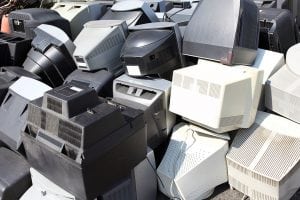 A draft European Union law limits traces of a flame retardant in products to such a low level that it would effectively kill e-plastics recycling on the continent, two industry groups said.
The brominated flame retardant in question is called decabromodiphenyl ether (decaBDE).
A draft European Union law limits traces of a flame retardant in products to such a low level that it would effectively kill e-plastics recycling on the continent, two industry groups said.
The brominated flame retardant in question is called decabromodiphenyl ether (decaBDE). A partnership between a processor and a prison in the U.K. is training inmates in dismantling electronics within the prison walls.
U.K. e-scrap operator Recycling Lives has set up an workshop inside HMP Dovegate, a privately run prison in Staffordshire, England.
A partnership between a processor and a prison in the U.K. is training inmates in dismantling electronics within the prison walls.
U.K. e-scrap operator Recycling Lives has set up an workshop inside HMP Dovegate, a privately run prison in Staffordshire, England.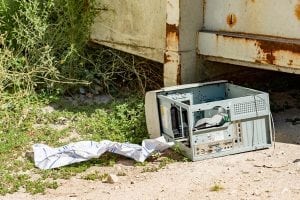 Device scavenging is hampering formalized electronics recycling efforts in Europe, and a new study concludes there is little established processors can do to stop it.
But companies can take steps to reduce its impact on their operations, according to research from the European Electronics Recyclers Association (EER
Device scavenging is hampering formalized electronics recycling efforts in Europe, and a new study concludes there is little established processors can do to stop it.
But companies can take steps to reduce its impact on their operations, according to research from the European Electronics Recyclers Association (EER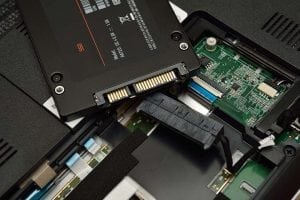 Solid state device data erasure is slated be added to the National Association for Information Destruction (NAID) certification standard.
Electronics recycling and ITAD operations for years have been asking for solid state device (SSD) data destruction to be included within the scope of NAID certification, according to a
Solid state device data erasure is slated be added to the National Association for Information Destruction (NAID) certification standard.
Electronics recycling and ITAD operations for years have been asking for solid state device (SSD) data destruction to be included within the scope of NAID certification, according to a