Researchers have compiled data on the global generation of used and end-of-life electronics, with an eye toward determining what the future e-scrap landscape will look like.
The study, titl
A bill making changes to Maine's electronics recycling framework became law after the legislature overrode the governor's veto.
Under Maine's extended producer responsibility (EPR) program for electronics, OEMs are charged the costs of recycling TVs and video game consoles based on the amount of new T
A company that has developed a bio-metallurgical recovery process for e-scrap is seeking investors to help the business scale up its operations, after reporting successful tests of the process.
New Zealand-based Mint Innovation is working to build its first metals recovery pilot plant in Auckland.
Missouri regulators plan to delete nearly all regulations under the state's electronics recycling program, but on-the-ground impacts may be limited.
As part of statewide efforts to cut red tape for businesses, the Missouri Department of Natural Resources (DNR) has
China supplies components for a lot of equipment used in the U.S. recycling industry, meaning tariffs on Chinese imports would be felt across many recycling sectors, according to an industry association.
The Institute of Scrap Recycling Industries (ISRI) submitted testimony to the U.S.
With the U.S. e-scrap industry continuing to rely on the export market, companies are not only contending with domestic laws and certification requirements - they're navigating a wide range of complex and unique international laws as well.
According to the Institute of Scrap Recycling Industries (ISRI), the U.S. e-scrap industry exports $1.45 billion worth of material annually.
[caption id="attachment_8732" align="alignright" width="300"] A computer tower with a tracking device provided by the Green Tracking Service (device at lower right).[/caption]
A U.S. company has begun providing an e-scrap tracking service so processors and OEMs can see where their downstream vendors are sending devices.
 Researchers have compiled data on the global generation of used and end-of-life electronics, with an eye toward determining what the future e-scrap landscape will look like.
The study, titl
Researchers have compiled data on the global generation of used and end-of-life electronics, with an eye toward determining what the future e-scrap landscape will look like.
The study, titl A bill making changes to Maine's electronics recycling framework became law after the legislature overrode the governor's veto.
Under Maine's extended producer responsibility (EPR) program for electronics, OEMs are charged the costs of recycling TVs and video game consoles based on the amount of new T
A bill making changes to Maine's electronics recycling framework became law after the legislature overrode the governor's veto.
Under Maine's extended producer responsibility (EPR) program for electronics, OEMs are charged the costs of recycling TVs and video game consoles based on the amount of new T A company that has developed a bio-metallurgical recovery process for e-scrap is seeking investors to help the business scale up its operations, after reporting successful tests of the process.
New Zealand-based Mint Innovation is working to build its first metals recovery pilot plant in Auckland.
A company that has developed a bio-metallurgical recovery process for e-scrap is seeking investors to help the business scale up its operations, after reporting successful tests of the process.
New Zealand-based Mint Innovation is working to build its first metals recovery pilot plant in Auckland. California regulators are accusing e-scrap processor Metech Recycling of violating hazardous waste management laws.
 Missouri regulators plan to delete nearly all regulations under the state's electronics recycling program, but on-the-ground impacts may be limited.
As part of statewide efforts to cut red tape for businesses, the Missouri Department of Natural Resources (DNR) has
Missouri regulators plan to delete nearly all regulations under the state's electronics recycling program, but on-the-ground impacts may be limited.
As part of statewide efforts to cut red tape for businesses, the Missouri Department of Natural Resources (DNR) has  China supplies components for a lot of equipment used in the U.S. recycling industry, meaning tariffs on Chinese imports would be felt across many recycling sectors, according to an industry association.
The Institute of Scrap Recycling Industries (ISRI)
China supplies components for a lot of equipment used in the U.S. recycling industry, meaning tariffs on Chinese imports would be felt across many recycling sectors, according to an industry association.
The Institute of Scrap Recycling Industries (ISRI)  With the U.S. e-scrap industry continuing to rely on the export market, companies are not only contending with domestic laws and certification requirements - they're navigating a wide range of complex and unique international laws as well.
According to the Institute of Scrap Recycling Industries (ISRI), the U.S. e-scrap industry exports $1.45 billion worth of material annually.
With the U.S. e-scrap industry continuing to rely on the export market, companies are not only contending with domestic laws and certification requirements - they're navigating a wide range of complex and unique international laws as well.
According to the Institute of Scrap Recycling Industries (ISRI), the U.S. e-scrap industry exports $1.45 billion worth of material annually. A Feb.
 It’s been 15 years since California’s e-scrap program was launched, and those years have brought significant changes to the end-of-life device stream.
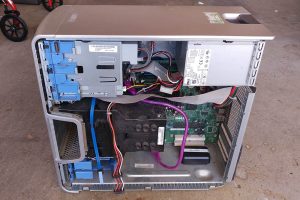 A computer tower with a tracking device provided by the Green Tracking Service (device at lower right).[/caption]
A U.S. company has begun providing an e-scrap tracking service so processors and OEMs can see where their downstream vendors are sending devices.
A computer tower with a tracking device provided by the Green Tracking Service (device at lower right).[/caption]
A U.S. company has begun providing an e-scrap tracking service so processors and OEMs can see where their downstream vendors are sending devices.