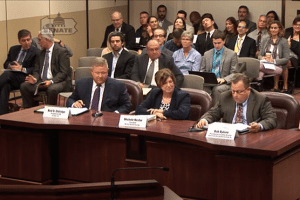
 Lawmakers hear testimony from Ned Eldridge of eLoop (left), Michele Nestor of Nestor Resources and Bob Bylone of the Pennsylvania Recycling Markets Center.[/caption]
Manufacturers say proposed changes to Pennsylvania’s e-scrap program would make it the worst in the country from an OEM perspective.
Lawmakers hear testimony from Ned Eldridge of eLoop (left), Michele Nestor of Nestor Resources and Bob Bylone of the Pennsylvania Recycling Markets Center.[/caption]
Manufacturers say proposed changes to Pennsylvania’s e-scrap program would make it the worst in the country from an OEM perspective. Rhode Island’s e-scrap law received some updates this month, requiring certain manufacturers to join the state-run collection program while allowing more flexibility for OEMs running independent plans.
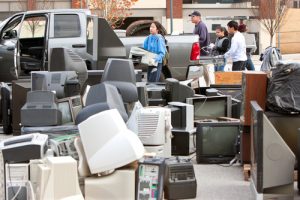 Regulators in California are studying a number of legislative fixes to the nation's longest-running e-scrap program, including expanding the existing consumer-funded model or going with a more commonly used system financed by OEMs.
In an
Regulators in California are studying a number of legislative fixes to the nation's longest-running e-scrap program, including expanding the existing consumer-funded model or going with a more commonly used system financed by OEMs.
In an  A confluence of factors has led logistics experts to predict that American firms, including those in the recycling industry, will experience higher over-the-road shipping costs in the next six months.
The current truckload market is already the tightest in four years.
The largest issue is a growing economy.
A confluence of factors has led logistics experts to predict that American firms, including those in the recycling industry, will experience higher over-the-road shipping costs in the next six months.
The current truckload market is already the tightest in four years.
The largest issue is a growing economy. Proposed legislation dramatically overhauls Pennsylvania’s e-scrap program, adding a point-of-sale fee on certain devices and making manufacturers financially responsible for end-of-life management of all devices collected under the law.
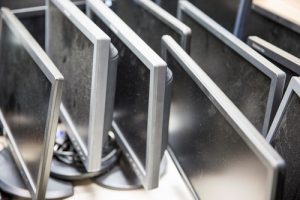 Seattle-based processor Total Reclaim has been fined by state regulators, who allege it speculatively accumulated mercury-bearing flat-panel TVs and monitors.
The $67,500 fine was
Seattle-based processor Total Reclaim has been fined by state regulators, who allege it speculatively accumulated mercury-bearing flat-panel TVs and monitors.
The $67,500 fine was 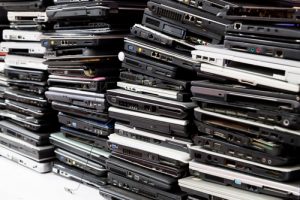 Environmental advocacy group Greenpeace has scored a handful of the top consumer electronics manufacturers on the recyclability of their devices, among other criteria.
 Sarah Murray of the Wisconsin Department of Natural Resources speaks at E-Scrap 2017.[/caption]
When it comes to CRT management, the profit is shaky and the industry is littered with horror stories of stockpiles and legal battles to determine who pays for cleanup.
But a company can take steps to avoid those pitfalls if it co
Sarah Murray of the Wisconsin Department of Natural Resources speaks at E-Scrap 2017.[/caption]
When it comes to CRT management, the profit is shaky and the industry is littered with horror stories of stockpiles and legal battles to determine who pays for cleanup.
But a company can take steps to avoid those pitfalls if it co Japan's Mitsubishi Materials is planning to invest over $100 million to boost its global e-scrap processing footprint.
The investment will see the firm spend up to $107 million in several new facilities in Japan and one in the Netherlands, according to a
Japan's Mitsubishi Materials is planning to invest over $100 million to boost its global e-scrap processing footprint.
The investment will see the firm spend up to $107 million in several new facilities in Japan and one in the Netherlands, according to a  Stakeholders have come to settlements in lawsuits over an explosion caused by batteries from used electronics in North Carolina.
In July 2016, a four-alarm fire at a Wilson Trucking shipping center in Charlotte, N.C. sent six employees to the hospital and caused substantial damage.
Stakeholders have come to settlements in lawsuits over an explosion caused by batteries from used electronics in North Carolina.
In July 2016, a four-alarm fire at a Wilson Trucking shipping center in Charlotte, N.C. sent six employees to the hospital and caused substantial damage.