
Researchers analyzing particle samples from an e-scrap facility found concentrations of a previously undetected, potentially toxic chemical.
Scientists at Indiana University (IU) detected tri(2,4-di-t-butylphenyl) phosphate, or TDTBPP, which is part of a family of chemicals known to be toxic.
 A growing number of U.S.
 End-of-life electronics received attention at the World Economic Forum meeting this month.
 E-scrap processor Cascade Asset Management saw resale prices rise for devices it handled over the past year, according to the company's recently released annual report.
The document, titled "
E-scrap processor Cascade Asset Management saw resale prices rise for devices it handled over the past year, according to the company's recently released annual report.
The document, titled " The U.S.
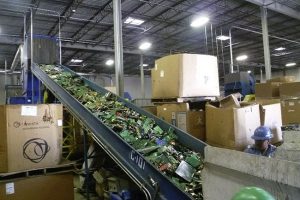 Results of a new study suggest e-scrap workers must wipe their hands multiple times at the end of their shifts to remove toxic flame retardants.
The study was conducted by scientists at the National Institute for Occupational Safety and Health (NIOSH), Harvard T.H.
Results of a new study suggest e-scrap workers must wipe their hands multiple times at the end of their shifts to remove toxic flame retardants.
The study was conducted by scientists at the National Institute for Occupational Safety and Health (NIOSH), Harvard T.H. Aubrey Arain attaches an air sampling pump to an e-scrap worker to measure contaminants in the air he breathes.[/caption]
Researchers from the University of Michigan are studying and finding ways to mitigate health risks from informal electronics recycling practices in Chi
Aubrey Arain attaches an air sampling pump to an e-scrap worker to measure contaminants in the air he breathes.[/caption]
Researchers from the University of Michigan are studying and finding ways to mitigate health risks from informal electronics recycling practices in Chi Callie Babbitt[/caption]
 Even if consumers say smartphone repairability is important to them, brand popularity may be a more important factor in prolonging a device's life, a study concluded.
"Our results suggest that although repairability and large memory size are typically thought to be 'life extending,' in practice they have limited impact on th
Even if consumers say smartphone repairability is important to them, brand popularity may be a more important factor in prolonging a device's life, a study concluded.
"Our results suggest that although repairability and large memory size are typically thought to be 'life extending,' in practice they have limited impact on th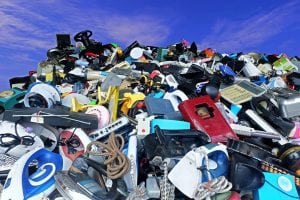 Yale University researchers estimate 3.5 million metric tons of electronics ended up in U.S.